Housekeeper smoothing white bed linens in a hotel room
Last updated: November 19, 2026
How to Store Pillow Covers Between Seasons Without Musty Odors starts with one number: dry them fully before packing them away. Store pillow covers in a dry, breathable container after they have aired out completely. The steps below settle the drying, packing, and closet storage choices that keep odor down.
The fastest way to keep pillow covers from smelling musty
Store pillow covers in a dry, breathable container after they have aired out completely. That simple move does more than any scented sachet, because musty odor usually starts with leftover dampness and stale air, not with the fabric itself.
Picture this: you’ve folded pillow covers after the last cool night of the season, and now they’re going into the back of a closet for 3 or 4 months. If they go in even a little damp, musty odor can settle in by the time you open the bin again. A cotton storage bag or breathable bin lets air move; sealed plastic traps whatever is already there.
Here’s the catch: clean-looking fabric is not the same as dry fabric. A cover can feel fine at room temperature and still hold enough moisture from washing, humid weather, or a stuffy laundry room to create trouble later.
Use this first-pass rule:
- Dry the covers until they feel fully crisp, not cool or clammy.
- Keep them out of the bathroom, basement floor, or laundry pile.
- Add silica gel packets only after the fabric is dry.
- Choose closet storage over attic storage if the closet stays cooler and drier.
The best part is that you do not need a special textile system to make this work. You need dry fabric, moving air, and a container that does not lock in moisture.
How do you store pillow covers between seasons?

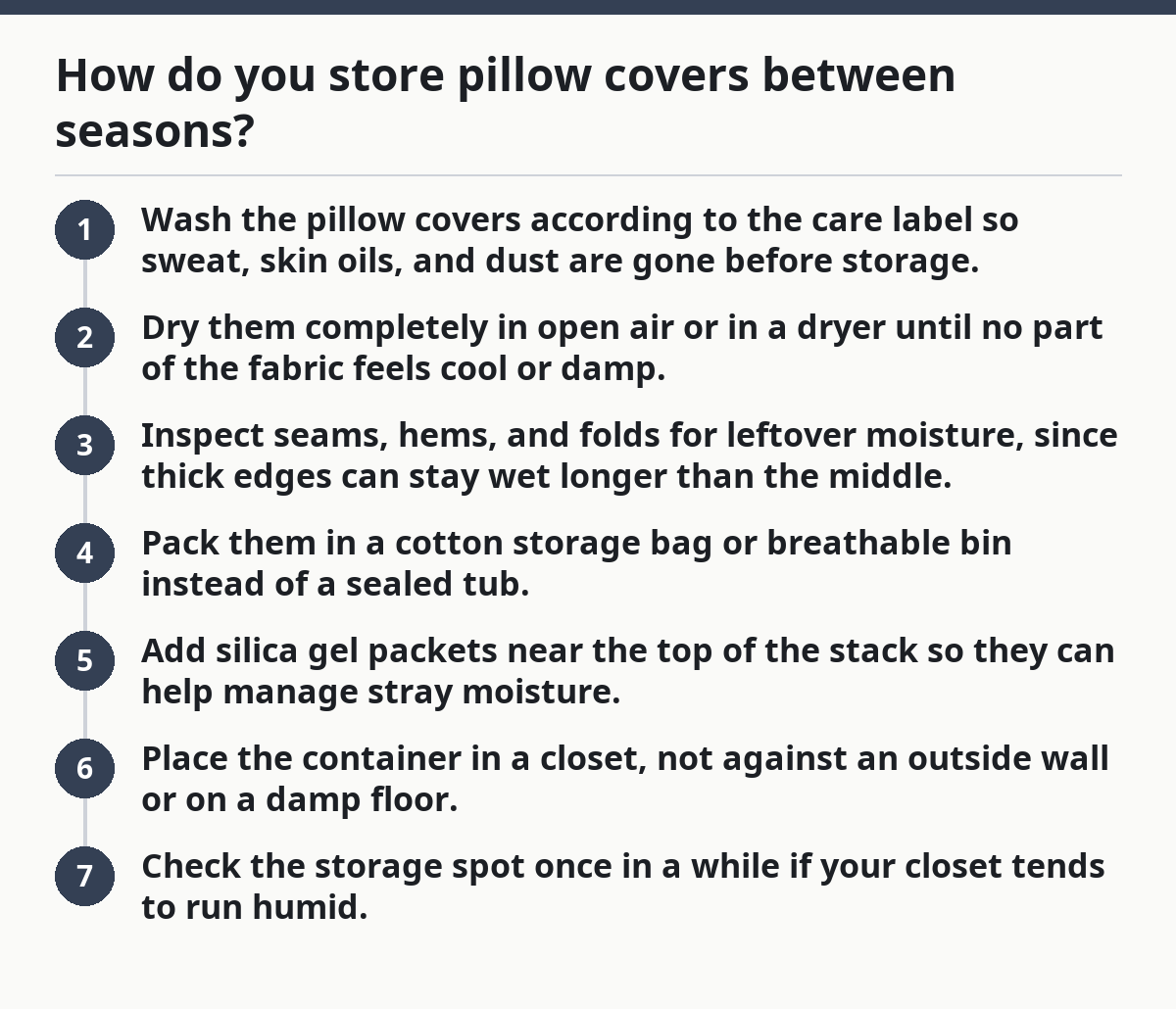
You store pillow covers by cleaning them first, drying them all the way, then packing them in a breathable container with moisture control. That order matters, because any shortcut at the front end gets buried for months.
Picture this: you’re rotating home textiles and want pillow covers out of sight until next season. The goal is not just to hide them; it is to keep them from collecting the stale, closed-in smell that shows up after 3 or 4 months in storage.
- Wash the pillow covers according to the care label so sweat, skin oils, and dust are gone before storage.
- Dry them completely in open air or in a dryer until no part of the fabric feels cool or damp.
- Inspect seams, hems, and folds for leftover moisture, since thick edges can stay wet longer than the middle.
- Pack them in a cotton storage bag or breathable bin instead of a sealed tub.
- Add silica gel packets near the top of the stack so they can help manage stray moisture.
- Place the container in a closet, not against an outside wall or on a damp floor.
- Check the storage spot once in a while if your closet tends to run humid.
A clean pillow cover that goes into a dry closet in a breathable bag has a much better chance of coming out fresh. A pillow cover packed away warm, damp, or tightly sealed does not.
You can also rotate by season in the same closet shelf if space is tight. Just keep the off-season covers separate from daily-use textiles so they do not pick up body odors or room smells.
For more on fabric care, see the pillow cover care and maintenance guide. For storage setup ideas, the seasonal home textiles storage page explains closet placement. If humidity is the issue, the how to reduce closet humidity guide covers moisture control.
What should you use: cotton storage bags, breathable bins, or plastic?
Cotton storage bags and breathable bins are usually the safest choices for odor control, while plastic containers are a weaker choice for long-term storage. The reason is simple: air exchange helps prevent trapped moisture from turning into mustiness.
Picture this: you’re standing in front of a shelf with a cloth drawstring bag in one hand and a lidded plastic tub in the other. The cloth bag is the better fit for pillow covers that will sit through a whole off-season, because it lets the fabric breathe instead of sealing it in.
Breathable options work best:
- Cotton storage bags for a small stack of folded covers
- Breathable bins with vents or loose-fitting lids
- Open closet shelving inside a clean fabric bag
- Shelf baskets lined with cotton, not plastic wrap
Plastic can still work in a dry home for short periods, but it is a weaker choice if the covers are not perfectly dry. A little trapped moisture can make the inside of a box smell stale fast, and that smell can transfer to the fabric.
Silica gel packets help, but they do not fix bad storage. They are a support tool, not a rescue plan. If the room is damp, a packet inside a sealed container is not enough on its own.
According to the U.S. Environmental Protection Agency, indoor relative humidity is often best kept between 30% and 50% to help limit dampness problems. The EPA guidance on mold and moisture supports the same point: moisture control matters more than fragrance.
Why the container matters
A storage container does two jobs at once: it protects the fabric from dust and it either helps or hurts moisture control. Breathable storage does the first job without making the second job worse.
Use a cotton bag if:
- you want the simplest option
- the covers are lightweight
- the closet stays reasonably dry
Use a breathable bin if:
- you need structure
- you stack several sets together
- the shelf gets dusty
Skip plastic if:
- your home gets humid in summer
- the storage area sits in a basement or garage
- the covers are made from a fabric that holds moisture easily
How do I make sure pillow covers are dry enough?
Pillow covers are dry enough when they feel room-temperature, crisp, and free of any cool or clammy spots. That sounds basic, but it is the step most people rush.
Picture this: you’ve just finished laundry day, and the covers are folded while still slightly warm. Warm fabric can fool you. As it cools, hidden moisture shows up, and that is the moisture that can make a closet smell stale after a few weeks.
Then use this simple check:
- Press the thickest seam between your fingers.
- Smell the inside fold, not just the outer face.
- Unfold the corners and hem once before packing.
- Let them sit in open air longer if the room itself feels humid.
A sunny windowsill is not required, but airflow helps. A drying rack, a clean chair back, or a laundry line in a dry room works better than a closed hamper. Even 30 extra minutes of open air can matter more than a scented insert.
The truth is, many “musty storage” problems start with fabric that was folded too soon. A pillow cover does not need to be hot from the dryer; it needs to be dry all the way through.
If your home is damp, wait longer than you think you need. That is boring advice. It also helps prevent the smell you are trying to avoid. If dampness keeps returning, the Mayo Clinic mold and moisture guidance recommends fixing the source rather than masking the odor.
Where should pillow covers live in the closet?
Pillow covers should live on a high, dry closet shelf or in another indoor space that stays stable through the season. Closet storage is usually better than attic, garage, or basement storage because the temperature and humidity swings are smaller.
Picture this: you’re choosing between a bedroom closet and a storage corner in the garage. The closet usually wins, because pillow covers do better where air stays calmer and moisture has fewer chances to build up.
Good closet habits:
- Keep the bag or bin off the floor.
- Leave a little space around the container.
- Avoid the wall that feels cold or damp.
- Put the covers away from shoes, wet towels, and cleaning supplies.
- Use the same shelf for all off-season home textiles if that shelf stays dry.
Bad storage spots:
- basements with a damp smell
- garages that heat up and cool down fast
- bathrooms
- laundry rooms that stay humid after washing
A closet shelf does not have to be perfect. It just has to be drier than the places where air sits still and moisture lingers. That is why closet storage shows up so often in textile care: it is simple, and simple often beats clever.
If you have limited space, place the pillow covers in a cotton storage bag and tuck that bag into a breathable bin on a closet shelf. That gives you two layers of dust protection without sealing the fabric in plastic. The American Cleaning Institute’s storage tips also point readers toward dry, breathable household storage.
Common storage mistakes that cause odor
The biggest mistake is packing pillow covers while they are still damp, and the second is sealing them in plastic for months. Both choices trap moisture, and trapped moisture is what turns into a musty smell.
Picture this: you open a bin in late summer and get hit with a stale, closed-up odor. That smell usually did not appear overnight. It built slowly because the covers were stored in a way that kept air out and dampness in.
Avoid these mistakes:
- Packing too soon after washing, which locks in hidden moisture
- Using plastic tubs for long storage, which can trap humidity
- Storing on the floor, where cool concrete can encourage dampness
- Mixing with unwashed linens, which transfers body oils and odor
- Skipping silica gel packets in a humid closet, which leaves no moisture buffer
What to do instead is plain:
- dry longer than you think you need
- choose breathable containers
- keep storage in a dry closet
- separate seasonal covers from everyday dirty laundry
One more common slip: adding heavy fragrance to cover a smell that is already there. That does not fix the storage problem. It just masks it for a while. If the fabric starts to smell off, the real answer is to air it out and check the storage setup, not to bury it under scent.
This is the part people miss. Odor control is mostly storage control.
What if your home is humid?
If your home is humid, you need stricter moisture control and a more careful storage spot. Humidity makes it harder for pillow covers to stay dry in storage, so the container choice and closet location matter even more.
Picture this: it is warm for months, the closet feels a little heavy in the air, and the pillow covers are going away until next season. In that kind of home, a breathable bin plus silica gel packets is a better bet than a plain shelf or sealed box.
Use these adjustments:
- Store in the driest room you have.
- Keep the container away from outside walls.
- Refresh silica gel packets if they stop feeling effective.
- Air the covers out briefly every few weeks if the storage space runs damp.
- Use cotton storage bags inside a breathable bin for an extra layer.
Do not put the covers in plastic just because the room feels muggy. That choice usually makes the problem worse, not better. The moisture has nowhere to go.
If you live in a humid climate, short seasonal storage is easier than long storage. Rotate the covers more often, and inspect them before the next use. That habit is part of keeping home textiles fresh, and it works better than trying to “set and forget” them for half a year.
For broader textile care, the hub on pillow cover care and maintenance covers the next step after storage: keeping them ready for the next rotation without creating extra wear.
Key takeaways
- Dry pillow covers fully before they go away for the season.
- Cotton storage bags and breathable bins are better than sealed plastic.
- Silica gel packets help only when the fabric is already dry.
- A cool, dry closet beats a basement, garage, or bathroom.
- Musty odor usually starts with trapped moisture, not with age alone.
How do you keep pillow covers from smelling musty in storage?
Keep pillow covers dry, breathable, and off the floor. Musty odor usually starts when fabric is folded away with leftover moisture or stored in a closed plastic container. A cotton storage bag with silica gel packets in a dry closet is a much safer setup for off-season storage.
What should you store pillow covers in for long-term storage?
Store pillow covers in a cotton storage bag or a breathable bin. Those options let air move while still protecting the fabric from dust. For long-term storage, keep the container in a closet rather than a basement or garage, since stable indoor air helps prevent stale odor.
Can pillow covers be stored in plastic containers?
They can, but plastic containers are not the best choice for long-term storage. If the pillow covers are not completely dry, plastic can trap moisture and lead to musty smells. A breathable container is the better fit, especially in a humid home or a warm storage space.
Drafted with AI; not yet reviewed by a person.
About the Author