How to Choose Pillow Cover Backing Fabrics for Comfort and Durability
Last updated: November 19, 2026
Key Takeaways
- Match the backing to how the pillow will be used, then weigh softness, stretch, airflow, and shape retention.
- Cotton backing often works well for comfort; polyester usually holds shape better; linen feels drier and cooler; woven backing adds structure; knit backing adds stretch.
- Cotton or linen often feel best against skin, while polyester or a firm woven backing usually helps a pillow keep its shape.
- Check touch, stretch, airflow, and seam stability in that order when choosing a backing.
Pillow cover backing fabric affects how a pillow feels against skin, how well it holds its shape, and how long it lasts. In How to Choose Pillow Cover Backing Fabrics for Comfort and Durability, cotton, polyester, linen, knit, and woven backing fabrics each trade comfort for stability in different ways. The sections below settle which backing suits sleep, daily lounging, and long wear.
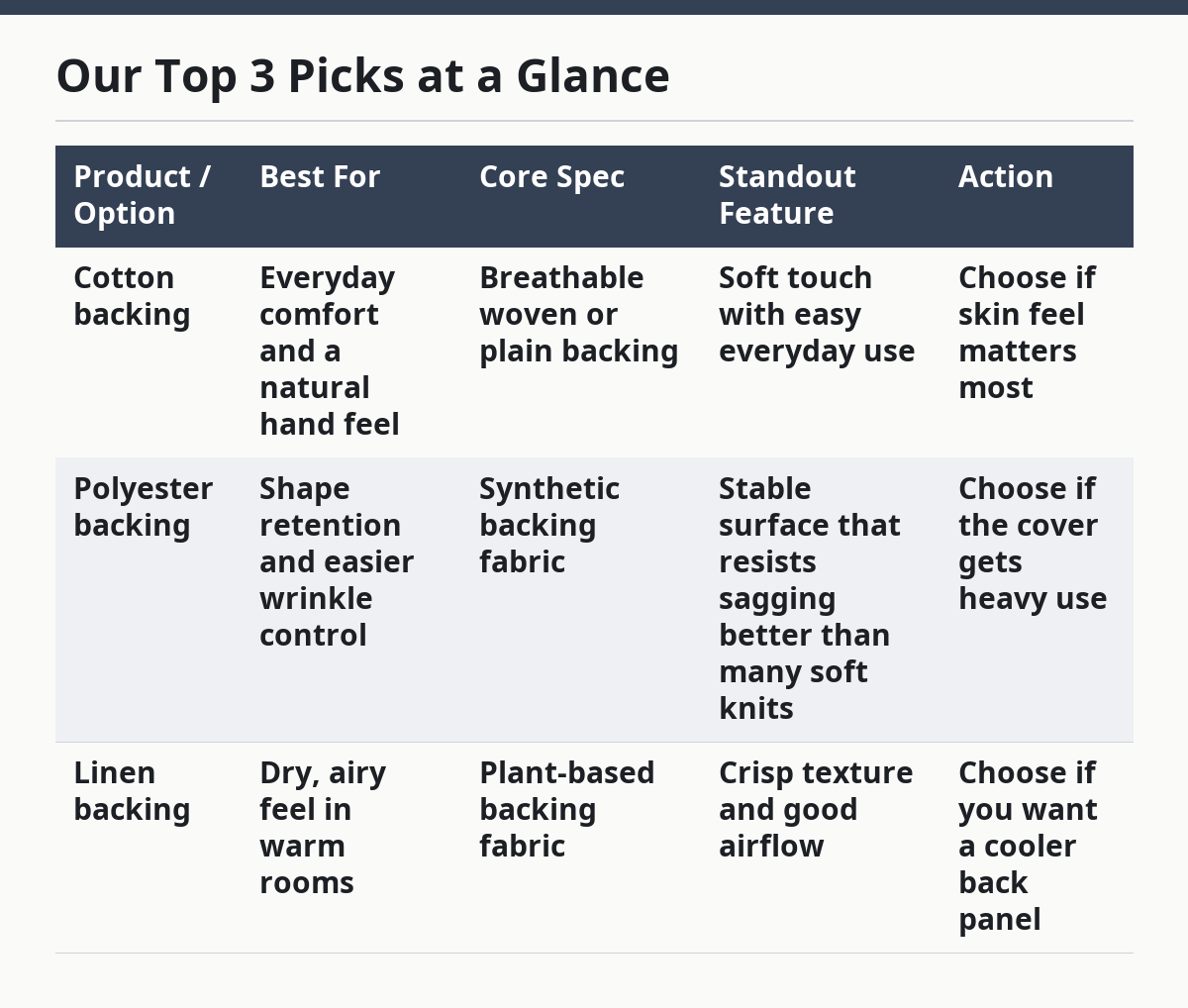
Our Top 3 Picks at a Glance
| Product / Option | Best For | Core Spec | Standout Feature | Action |
|---|---|---|---|---|
| Cotton backing | Everyday comfort and a natural hand feel | Breathable woven or plain backing | Soft touch with easy everyday use | Choose if skin feel matters most |
| Polyester backing | Shape retention and easier wrinkle control | Synthetic backing fabric | Stable surface that resists sagging better than many soft knits | Choose if the cover gets heavy use |
| Linen backing | Dry, airy feel in warm rooms | Plant-based backing fabric | Crisp texture and good airflow | Choose if you want a cooler back panel |
Which pillow cover backing fabric should you choose first?
Choose the backing fabric that matches how the pillow will be used, then check whether you care more about softness, stretch, airflow, or shape retention. If the pillow sits on a sofa for hours, a stable woven backing usually makes more sense than a stretchy knit.
For a quick starting point, think in three use cases. Bed pillow covers usually benefit from softer backing, accent pillows can use firmer backing, and high-traffic cushions need better shape control.
Picture this: you’re buying a pillow cover that looks perfect on the front, but the back rubs rough, sags after a few weeks, or traps heat when you lean on it. That’s where backing fabric decides the real-life comfort.
Start with use case:
- Bed pillow covers need a softer backing, often cotton or linen, because skin contact lasts longer.
- Accent pillows can use firmer polyester or woven backing if the cover is mostly decorative.
- High-traffic cushions need a backing that keeps its shape after repeated stuffing and unstuffing.
Here’s the catch: the backing is not just a hidden panel. It changes the feel of the whole cover, especially around seams and closures.
- Softest feel: cotton
- Coolest feel: linen
- Most stable: woven polyester blends
- Most flexible: knit backing
A generic “nice fabric” choice often fails here because it ignores one thing: the back of the pillow is the part your hand, cheek, or arm touches first.
How do cotton, polyester, linen, woven, and knit backing fabrics compare?
Cotton backing is often the most comfortable all-around starting point, polyester is usually the most shape-holding, linen feels the driest and coolest, woven backing gives structure, and knit backing gives stretch. The trade-offs matter more than the label.
Picture this: you’re holding two covers that look nearly identical from the front. One back feels crisp and flat. The other feels springy and slightly stretchy. That tiny difference changes how the pillow sits, how it closes, and how long the seams stay neat.
Cotton backing
Cotton backing works well when comfort matters more than stiffness. It usually feels familiar against skin, breathes well, and does not feel slick.
- Good for daily use and frequent contact
- Usually easier to live with in warm rooms
- Can wrinkle more than synthetic backing
- May soften with washing, which many people like
Polyester backing
Polyester backing suits pillows that need a firmer, more controlled shape. It tends to resist wrinkles better than cotton and can feel smoother under a cover.
- Useful for decorative pillows that must look sharp
- Holds its form better than many soft natural backings
- Can feel less breathable than cotton or linen
- May feel less natural against skin
Linen backing
Linen backing gives a dry, airy feel and a more textured hand. It works well when you want the pillow to feel cool and light rather than plush.
- Often feels cooler in warmer rooms
- Strong enough for regular use
- Can feel crisp, even slightly scratchy, at first
- Wrinkles are part of the look, not a defect
Woven fabric backing
Woven backing usually gives more structure than knit backing. That makes it a good choice when the cover needs to keep its edges crisp and its opening neat.
- Better for clean lines and stable seams
- Less likely to stretch out of shape
- Can feel firmer against skin
- Breathability depends on the fiber, not just the weave
Knit fabric backing
Knit backing stretches more easily and feels softer in motion. That can help with inserts that are slightly oversized or pillows that need flexibility.
- Easier to fit around fuller inserts
- More forgiving during stuffing and removal
- Can lose shape faster than woven backing
- Not ideal when you want a crisp, tailored look
The truth is, fiber and construction work together. A cotton knit feels very different from a cotton woven back, even though both are cotton.
What feels best against skin, and what wears best?
The most skin-friendly backing is usually cotton or linen, while the most durable choice for shape retention is usually polyester or a firm woven backing. Comfort and durability often pull in opposite directions, so the right answer depends on where the pillow lives.
Picture this: you’re reading in bed, and the pillow slides under your cheek for an hour. A backing that feels only slightly rough at first can become a daily annoyance. On the flip side, a very soft backing that stretches out can make the pillow look tired fast.
The first thing to notice is touch. If the pillow is likely to touch bare skin, choose a backing with a natural hand and low scratchiness. If the pillow is mostly visual, durability can take priority.
| What you want | Better backing choice | Why |
|---|---|---|
| Soft contact | Cotton or linen | Gentler against skin |
| Cleaner shape | Woven polyester | Better structure over time |
| Cooler feel | Linen | Airier, drier hand |
| Easier fit | Knit | More stretch during assembly |
A common mistake is assuming “strong” means “comfortable.” A dense synthetic backing can survive longer, but it may also feel warmer and less pleasant for lounging.
- Best for face contact: cotton or linen
- Best for holding edges: woven polyester
- Best for flexible inserts: knit backing
- Least forgiving for skin feel: stiff synthetics without soft finish
If the cover will sit behind your head every night, don’t pick the backing only for looks. Pick the one you can live with for 8 hours at a time.
How do you match backing fabric to the pillow’s job?
Match the backing to the pillow’s job by checking touch, stretch, airflow, and seam stability in that order. A decorative pillow and a sleeping pillow need different backing behavior, even if they use the same front fabric.
Picture this: you’re choosing fabric for a throw pillow in a living room that gets used every day. The pillow gets leaned on, tossed aside, and re-stuffed after cleaning. That pillow needs a backing that can take handling, not just one that looks good on the bolt.
Use this simple procedure:
- Place the pillow near the body part that will touch it most often. For cheek, neck, or bare arms, favor cotton or linen backing.
- Decide how much the cover needs to stretch. For tight inserts or rounded shapes, a knit backing can make fitting easier; for crisp corners, choose a woven backing.
- Check the room’s heat and humidity. For warmer spaces, linen or cotton usually feels less sticky than many synthetics.
- Think about handling. If the cover will be removed and refilled often, a more stable woven backing usually keeps seams aligned better.
- Balance comfort against wear. If the pillow is decorative first, polyester backing may be the better long-term shape holder.
Now, you might be wondering whether one fabric can do everything. Usually, no. A backing that feels great in hand may not keep its shape under repeated use.
Use cotton backing when…
- The pillow sits on a bed or sofa where skin contact is common.
- You want a natural feel without much fuss.
- You prefer a middle ground between softness and structure.
Use polyester backing when…
- The pillow is moved, stacked, or restuffed often.
- You want less wrinkling and more shape control.
- The cover needs to keep a neat silhouette.
Use linen backing when…
- The room runs warm.
- You want a cooler, more airy feel.
- You like a crisp, textured look that can age naturally.
A pillow cover often fails not because the front fabric is wrong, but because the backing was chosen as an afterthought. That’s the expensive mistake.
Common mistakes that shorten comfort and life
The biggest mistakes are choosing a backing that is too rough, too stretchy, or too warm for the way the pillow is used. Those errors cost you comfort first, then shape, then lifespan.
Picture this: you buy a beautiful cover, then notice the back pills, wrinkles badly, or feels hot every time you lean on it. The cover still looks fine on a shelf. On a couch, it becomes the wrong choice by week two.
Mistake 1: Choosing based on front fabric alone
That costs you a mismatch. A soft front with a stiff back can feel uneven, and a rich-looking front with a weak back can sag.
- What to do instead: choose the backing by use case, then match the front to it.
Mistake 2: Picking stretch when you need structure
That costs you shape. A knit backing can relax over time, especially on pillows that get handled a lot.
- What to do instead: use woven backing when the cover needs to keep straight edges or a fitted look.
Mistake 3: Choosing warmth when you need breathability
That costs you comfort in warm rooms. Some synthetics trap more heat than cotton or linen.
- What to do instead: pick cotton or linen for beds, reading corners, and summer spaces.
Mistake 4: Ignoring seam behavior
That costs you durability. A backing that shifts or stretches unevenly can stress the seams and opening.
- What to do instead: use a stable woven backing for covers that will be opened and closed often.
For broader material planning, the hub on pillow cover materials and construction is the right next stop. This page is only about the back panel, because that is where comfort and wear often get decided.
How do you make the final choice without overthinking it?
Make the final choice by ranking comfort, stability, and care needs in that order, then choosing the fabric that wins two out of three. If the backing feels wrong in the hand, the pillow will annoy you even if it lasts longer.
Picture this: you’re standing at the cutting table and trying to choose between two good fabrics. One feels softer. The other looks more stable. You do not need a perfect fabric. You need the right compromise for one pillow.
Use this quick filter:
- Choose cotton if you want the easiest all-purpose comfort pick.
- Choose polyester if shape retention matters more than a natural feel.
- Choose linen if coolness and airy texture matter most.
- Choose woven fabric if you want crisp structure.
- Choose knit fabric if you need stretch and easier stuffing.
Here’s the catch: there is no universal “best” backing fabric. A reading pillow, a sofa pillow, and a sleeping pillow ask for different things.
Two practical checks help more than guesswork:
- Rub the fabric against the inside of your wrist for 10 seconds. If it feels irritating there, it will probably bug you on a pillow.
- Pinch and pull the fabric once. If it grows loose quickly, expect less shape control.
That check tells you more about comfort and recovery than a product tag ever will.
What the shortlist usually means
- Cotton backing: comfort-first choice for many households
- Polyester backing: shape-first choice for busy rooms
- Linen backing: cool-feel choice for warmer spaces
- Woven backing: structure-first choice for neat edges
- Knit backing: flexibility-first choice for easier fitting
FAQ
What is the best backing fabric for a pillow cover?
Cotton backing is often the best starting point because it balances comfort, breathability, and everyday use. Linen is a better pick if you want a cooler, drier feel, while polyester is better if keeping shape matters more than softness.
Does the backing fabric change how a pillow cover feels?
Yes, the backing fabric changes both touch and behavior. A cotton or linen back feels more natural against skin, while a polyester or woven back can feel firmer and hold shape better. That difference shows up most when you lean, sleep, or rest your arm on the pillow for a while.
Drafted with AI; not yet reviewed by a person.
About the Author