How to Keep Pillow Covers Centered on the Insert
Last updated: November 19, 2026
Quick Answer: To keep pillow covers centered on the insert, place the insert squarely into the corners, smooth the fill, and zip the cover with the zipper on the back. That usually takes less than a minute once you know the sequence. Pillow covers slide because the pillow insert is shifting inside the cover or the cover is sitting off-center before you close it. In How to Keep Pillow Covers Centered on the Insert, the goal is to seat the insert, align the corners, and set the zipper position. The steps below settle the fit, alignment, and zipper position.
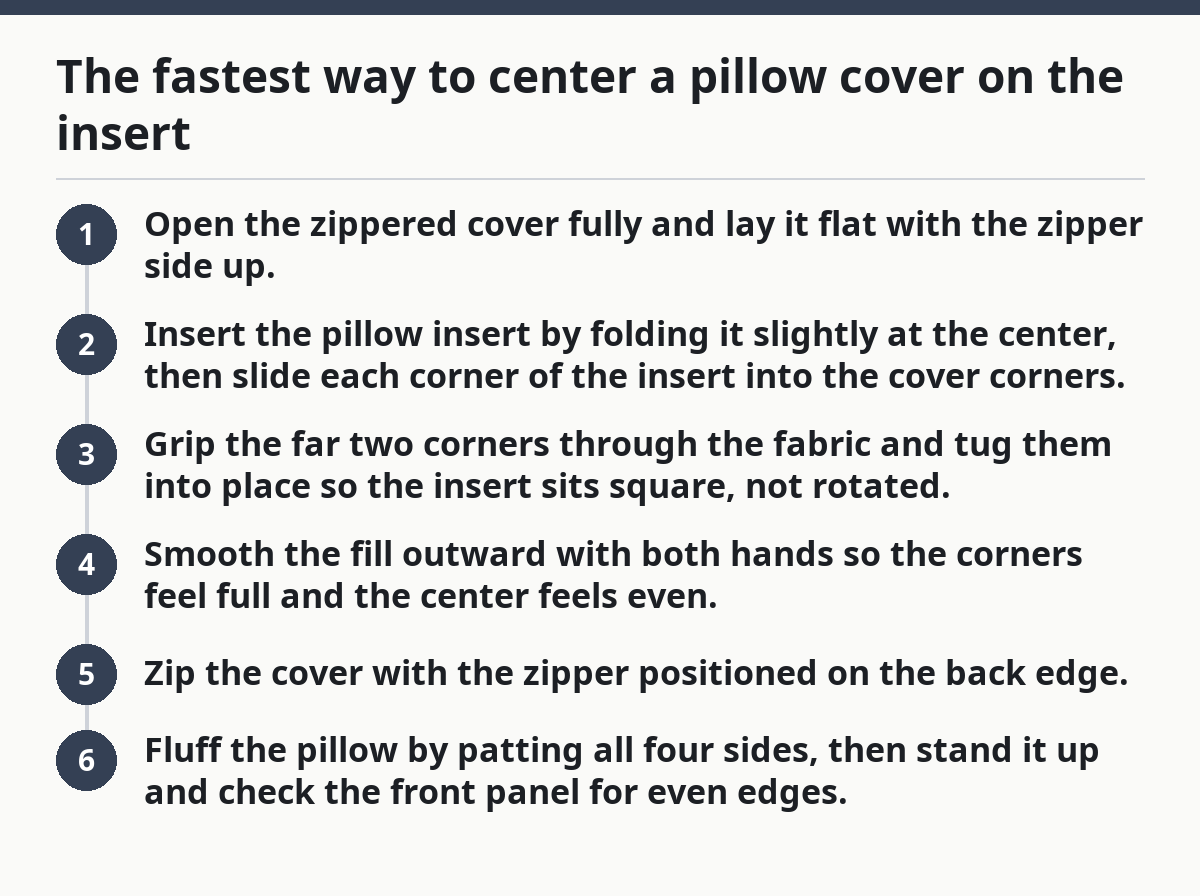
The fastest way to center a pillow cover on the insert
This is a quick way to center the pillow cover on the insert, not a guaranteed fix for every pillow. Picture this: you zip the cover closed, set the pillow on the sofa, and one corner keeps drooping while the middle bulges. The fix is usually a corner-to-corner fit, not a bigger cover, and it starts before the zipper closes.
- Open the zippered cover fully and lay it flat with the zipper side up.
- Insert the pillow insert by folding it slightly at the center, then slide each corner of the insert into the cover corners.
- Grip the far two corners through the fabric and tug them into place so the insert sits square, not rotated.
- Smooth the fill outward with both hands so the corners feel full and the center feels even.
- Zip the cover with the zipper positioned on the back edge.
- Fluff the pillow by patting all four sides, then stand it up and check the front panel for even edges.
The key is corner placement, not brute force. If the insert is square and the cover is square, the seams should line up with only a little hand adjustment.
- A flat, empty floor makes the corners easier to see.
- A zipper hidden along the bottom edge usually shifts less on a sofa.
- A pillow insert with more fill keeps its shape better than a soft, limp one.
The truth is, a good fit depends on the internal shape of the insert as much as the cover. A dense 20-inch insert behaves very differently from a loose 20-inch insert, even when the label size matches.
How do you keep pillow covers centered on the insert?
You keep pillow covers centered on the insert by anchoring the corners first, then forcing the fill to settle evenly before you close the zipper. That means corner seams, zipper position, and smooth fill all have to line up at once.
Here’s the catch: if you zip one side first, the insert twists with it. A cover can look centered for a minute, then drift as the fill relaxes.
Use this simple sequence:
- Hold the cover open with the zipper fully undone.
- Push one bottom corner of the insert into one bottom corner of the cover.
- Repeat on the opposite corner before worrying about the middle.
- Pull the top corners into place with short tugs, not one hard yank.
- Zip slowly while pressing the insert toward the back panel.
A zippered cover gives you the most control here because you can reopen it if the insert rotates. A sewn-shut cover gives you less room to correct the fit, which is why centered placement matters before the closure is final.
If the pillow still creeps, the problem is often the insert itself. A very soft fill can settle to one side after 10 or 15 minutes on the couch, especially if the pillow is used as a backrest.
Why does a pillow cover twist on the pillow insert?
A pillow cover twists because the insert is smaller, softer, or less square than the cover, so the fabric can rotate around it. The twist usually shows up at the corner seams first, then the front panel starts to skew.
Picture this: you set the pillow down, and one seam slides toward the top edge while the zipper sneaks off to one side. That’s rotation, not just looseness.
These are the common causes:
- The insert has too much empty space inside the cover.
- The fill is clumped, so one side carries more bulk.
- The zipper is centered when closed, but the insert was not centered first.
- The pillow gets handled from one side only, so the weight keeps pulling the same way.
A cover may also twist more if the insert has a very smooth outer shell. That fabric can let the fill slide inside, which changes the pillow’s balance after a few uses.
What helps most is a firmer insert and a slower closing routine. If the insert is already lopsided, no amount of tugging on the finished pillow will keep the cover centered for long.
Which corner and zipper moves matter most?
The corner that matters most is the one opposite the zipper, because that is where the insert can hide while the rest of the pillow looks right. The zipper itself should sit at the back edge, where your hand can still correct it after closing.
Start with the farthest corner from the opening. That corner sets the pillow’s square shape, and if it is off by even a little, the whole cover reads crooked on the sofa.
Do this with the opening still wide:
- Pinch the far corner of the insert.
- Pull it into the far cover corner.
- Repeat on the near side.
- Smooth the center only after the corners are seated.
Then close the zipper in short passes. If you zip all at once, the insert can bunch near the opening and pull the whole pillow off center.
A small, hidden corner seam is a better guide than the decorative face of the pillow. The face can look centered while the inside is already drifting.
How to fix a cover that keeps sliding out of place
You fix a cover that keeps sliding out of place by increasing friction inside the cover and reducing empty space around the insert. A pillow that shifts every day usually needs a better internal fit, not just a neater setup.
Picture this: you straighten the pillow in the morning, and by night it has turned half an inch or more. That usually means the insert is too loose, too soft, or too slick against the cover.
Try these corrections:
- Use an insert that fills the cover more fully at the corners.
- Replace a very limp insert with a firmer one if the shape keeps collapsing.
- Re-center the insert after every wash, because cleaned fabric often settles differently.
- Press the pillow flat from the center outward before the zipper is closed.
A smoother fill can still work, but only if the shell and the cover are close in shape. If the insert is too floppy, it will drift no matter how carefully you zip it.
This is where the article on the larger pillow cover fit, sizing, and construction topic helps, because fit problems often start before the pillow ever reaches the sofa. For construction details, compare zippered pillow covers with sewn pillow covers.
What not to do if you want the cover to stay centered
You should not force the zipper closed while the insert is bunched in one corner, because that locks the pillow into a skewed shape. The mistake is fast, but the bad shape lasts.
The most common errors are easy to spot:
- Zipping too soon: this traps the insert off-center.
- Pulling one corner only: this stretches one side and twists the rest.
- Ignoring the back edge: the zipper side can drift even when the front looks fine.
- Using a saggy insert: soft fill slides around instead of holding the corners.
The cost is simple: the pillow looks lopsided, and you keep fixing it every time you sit down. The fix is slower at the start, but it saves you from re-centering the same pillow all week.
If the cover is decorative and the pillow is mostly for display, a firmer insert is usually the better choice. If the pillow is used every day as a back cushion, expect more shifting and plan to fluff it more often. For care and filling comparisons, our how to choose a pillow insert page covers fill types and firmness.
A simple centering routine that takes less than a minute
This centering routine is a practical way to keep pillow covers centered on the insert, and it often takes under a minute once you repeat it. The best routine is to seat the corners, smooth the fill, and finish with the zipper at the back before the pillow ever hits the couch. That is the cleanest way to keep pillow covers centered on the insert without constant adjustment.
Use this quick routine:
- Place the cover flat.
- Insert one corner, then the opposite corner.
- Push the top corners into place.
- Smooth the center with both hands.
- Close the zipper.
- Fluff the edges and tap the seams.
Do this the same way every time, and the pillow will stay squarer. The routine is short, but it works because it respects the shape of the pillow insert instead of fighting it. If you want a step-by-step refresh after washing, see our pillow care and fluffing tips.
Key Takeaways
- Center the insert before you zip, not after the pillow is finished.
- Corners do the real work; the face fabric only shows the result.
- A zipper at the back is easier to correct and less likely to pull the pillow sideways.
- Loose fill causes drift, so a firmer insert usually holds its place better.
- If the pillow keeps twisting, the problem is often internal fit, not your folding.
How do you stop a pillow cover from shifting on the insert?
You stop a pillow cover from shifting on the insert by seating the corners first and keeping the fill evenly spread before closing the zipper. A cover that shifts usually has too much empty space or a soft insert that slides inside the shell. Re-center it by opening the zipper, straightening the corners, and smoothing the fill back out.
Why does a pillow cover twist on the pillow insert?
A pillow cover twists because the insert rotates inside the cover when the shape is too loose or the fill is uneven. The twist often starts at one corner seam and shows up more after the pillow has been used for a while. A firmer insert and a slower closing process usually reduce the problem.
How do you center an insert inside a pillow cover?
You center an insert inside a pillow cover by placing the far corners first, then matching the near corners before you zip the cover shut. The insert should sit square inside the seam lines, with the zipper on the back edge. If one side still looks off, open it and adjust the corners again before the fill settles.
Drafted with AI; not yet reviewed by a person.
About the Author