
Decorative pillows arranged on a bed
Last updated: November 18, 2026
Key Takeaways
- A pillow cover usually works best when the nominal size closely matches the insert, with a little negative ease.
- Measure the insert first, then choose between a crisp fit and a looser one.
- A snug cover looks more tailored; an easier one is simpler to remove and wash.
- Seam allowance, closure type, fabric stability, and whether the listed size is finished or insert size matter most.
A pillow cover fits best when its finished size matches the insert’s size closely and its construction gives the insert enough room to fill the corners without sagging. If the cover is too loose, the pillow looks limp; if it is too tight, the corners pull flat and the zipper or seam takes the strain. Pillow cover fit, sizing, and construction guide matters most when you are comparing nominal size to the actual insert.
I write about bedding construction, textile standards, and home textiles fit because those details decide whether a cover looks tailored or disappointing.
What size should a pillow cover be?
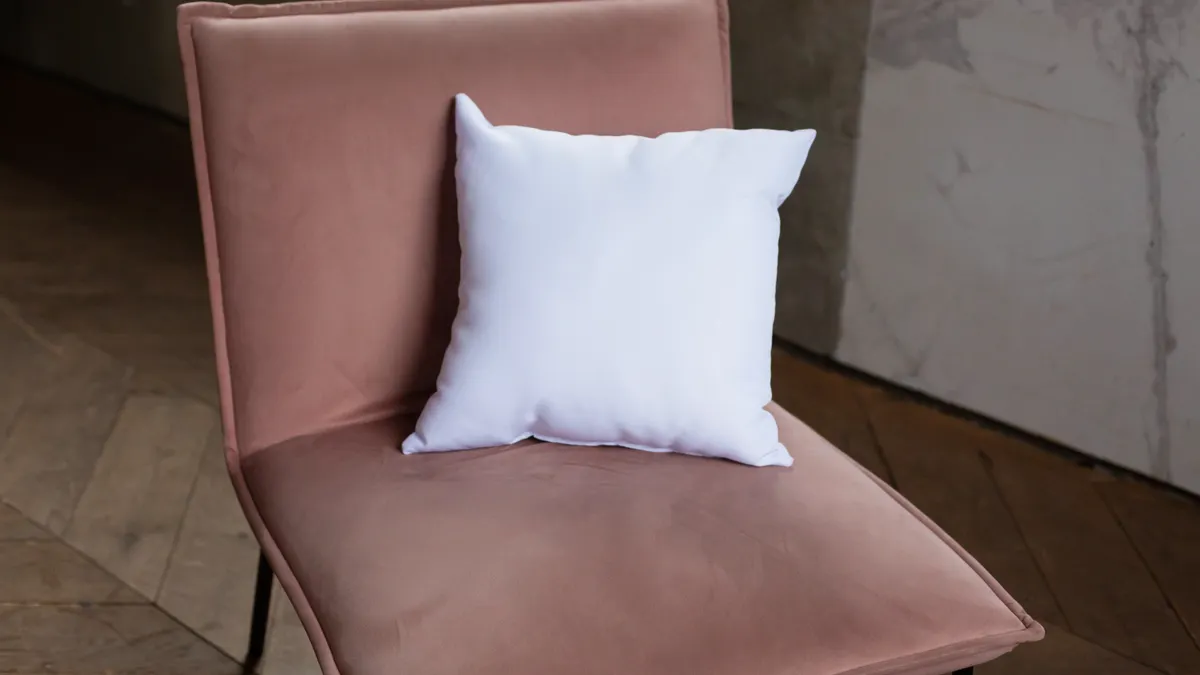
A pillow cover should usually be the same nominal size as the insert, with a small amount of “negative ease” so the fill pushes the edges out cleanly. For a square insert, a cover labeled 18 x 18 inches often fits best with an 18-inch insert if the cover fabric is structured, or a 17 x 17-inch cover if the insert is soft and compressible.
The basic rule is simple: the insert determines the shape, and the cover determines how firmly that shape shows. A 20 x 20-inch insert in a 20 x 20-inch cover will look plumper if the fill is dense, while the same cover on a flatter insert may look understuffed. Many makers of decorative covers use the stated dimension as the finished seam-to-seam size, but not all do. Some list the outer edge, some list the insert size they expect you to use, and some round to the nearest inch.
That is why the dimensions in the product listing matter more than the “fits standard pillow” phrase. If the cover is for a sofa cushion, the same issue appears in centimeters, not just inches. A 45 x 45 cm insert usually pairs with a 45 x 45 cm cover only when the fabric has enough body; linen-like weaves and cotton sateens behave differently because one relaxes more and one holds shape more firmly.
The safest purchase decision is usually to check three things before buying: the insert size you already own, the cover’s stated finished measurement, and whether the listing says “zippered,” “envelope closure,” or “button closure.” Those clues often tell you more about fit than the marketing copy does.
How do I choose the right pillow cover size?
Choose the cover size by measuring the insert first, then deciding whether you want a crisp, full look or a softer, looser look. For most square decorative inserts, the cover should match the insert size exactly or run about 1 inch smaller on each side if the fabric is not stretchy.
Start with the insert, not the old cover. Inserts compress over time, and a cover that once looked perfect may start reading as baggy after the fill settles. Lay the insert flat and measure its actual edge-to-edge dimension, then compare that number to the cover’s finished dimensions. If the insert measures 18.5 inches because the fill has puffed out the sides, a true 18-inch cover may feel snug in a good way. If the insert measures 17 inches because the filling is soft or sparse, the same cover will look fuller only if the shell fabric is firm enough to hold the shape.
Shape matters, too. A square decorative cushion and a Euro sham use different construction logic even when both are 26 inches. A bed sham often accepts a slightly larger insert because it is meant to look plush and dressed, while a throw cushion on a chair may need a tighter cover so it stays neat after daily use. If the cover is for a body pillow, the cover must also account for the insert’s lengthwise compression; a 20 x 54-inch insert can feel overstuffed if the seam allowance is narrow and the closure is short.
One practical caution: avoid sizing up too much unless you want a softer, slouchier result. A cover that is 2 inches larger than the insert on each side can show empty corners, especially on smooth fabrics like sateen or tightly woven cotton. That effect is fine if the goal is casual drape, but it is wrong for a formal, tailored look.
The difference between a snug cover and an easy one
A snug cover makes the insert look expensive; an easy cover makes it easier to remove and wash. The choice turns on the closure, the seam construction, and how much fill the insert actually has.
A snug fit is usually the better choice for decorative squares because it fills the corners and keeps the front panel flat. That is why many stylists prefer a cover that is about 1 inch smaller than the insert on each side, especially for feather or feather-blend inserts that can be shaped by hand. The downside is practical: a close fit can make the zipper hard to close if the insert is dense, and it can stress a weak seam at the opening.
An easy fit has real advantages for households that wash covers often or swap them seasonally. If a cover is meant to go on and off every week, a tiny bit of extra room can save time and prevent seam wear. It also helps with inserts that are unusually full, such as high-loft down-alternative fills or foam-filled shapes. The trade-off is visual. Too much ease creates wrinkles, empty corners, and a less tailored profile.
This is where the intended use matters more than the size label. A cover for a guest bed sham, used mainly for display, benefits from a firmer fit. A cover for a child’s reading nook cushion may need a little extra room because frequent removal matters more than perfect corners. For outdoor or high-traffic seating, a looser fit can also reduce zipper strain, but only if the insert still fills out the shell enough to avoid sagging.
The wrong choice is a cover that is loose for appearance reasons but not actually easier to live with. If the opening is short or the inner seams are weak, extra room does not solve the real problem; it just makes the cover look underfilled.
What construction details actually affect fit?
The construction details that matter most are seam allowance, closure type, fabric stability, and whether the maker expects the listed size to be the finished size or the insert size. Those four things affect fit far more than decorative trims do.
A 1/2-inch seam allowance leaves more usable interior space than a 5/8-inch seam allowance, and that difference matters on a small cover. On a 16 x 16-inch cover, a generous seam allowance can reduce the interior by more than a casual shopper expects. That is why two covers with the same listed size can fit the same insert differently. If the pattern is cut on the bias or the fabric is loosely woven, the shell may relax after a few uses, which changes the fit again.
Closure type also changes how the cover behaves. A hidden zipper gives the cleanest edge and usually the most controlled fit, but it requires enough opening length to get the insert in without stressing the teeth. Envelope closures are easier to sew and often easier to remove, but they can leave a little extra fabric at the back, which matters less for a sofa cushion and more for a bed sham where the back may be visible. Button closures can look handsome, yet the placket may open slightly if the insert is too full.
Fabric stability is the quiet factor people miss. A tightly woven cotton poplin or percale holds shape better than a drapey, loosely woven fabric. A napped or textured fabric may hide minor size issues, while a smooth fabric shows every wrinkle and slack corner. If the shell has no interfacing and the fabric is very soft, the cover may grow a little with use. That is not a defect in the abstract; it is simply the wrong construction for a precise fit.
If the listing does not specify the finished dimensions, seam type, or closure length, it is worth treating the size claim cautiously and, if needed, checking with the seller or a textile professional. That omission often matters more than the style name, and the Federal Trade Commission’s textile labeling guidance can help you interpret what the listing should clearly state: https://www.ftc.gov/business-guidance/resources/threading-your-way-through-labeling-requirements-under-textile-wool-acts.
Which construction details make a cover last longer?
The construction details that make a cover last longer are reinforced seams, a suitable closure, and fabric that matches the use case. A cover that looks good on day one but frays at the opening after a few washes is badly built, even if the dimensions were right.
A strong seam is not just a neat seam. It needs enough thread tension, enough seam allowance, and a finish that keeps raw edges from unraveling. In practice, that means a clean overlock or serged edge, a turned-under edge, or another finish that suits the fabric weight. Thin fabrics can fail at the seam before the front panel wears out. Heavy fabrics can put too much stress on an underbuilt zipper or button placket.
The opening is usually the first failure point. If the zipper is shorter than the insert opening requires, users tug the shell open farther than intended. If the zipper tape is weak or the stitch line is too close to the teeth, the slider can catch fabric. A well-placed hidden zipper should run long enough to admit the insert without forcing the corners through a narrow gap. That is one reason a 14-inch zipper on a 20-inch square cover is often less convenient than a longer one, even when the overall design looks neat.
Piping, flange edges, and border bands change both the look and the fit. A flange can make a cover appear larger without changing the center panel size, which is useful when the insert is slightly undersized. Piping adds structure but can make the opening less forgiving. These are styling choices with mechanical consequences.
Who should care most? Anyone buying covers for frequent laundering, rental use, or a busy family room. Who can care less? Someone buying a decorative sham that will stay in place and rarely be handled. Even then, weak construction shows up eventually, especially on smooth fabrics where wear is obvious.
How do square, lumbar, and bolster covers differ?
Square, lumbar, and bolster covers differ because each shape handles tension differently, so the same sizing rule does not always apply. Square covers are the easiest to size; lumbar and bolster covers demand more attention to length, loft, and seam placement.
A square cover is the most forgiving category. The insert pushes evenly into all four corners, and the visual result depends mainly on whether the shell is close enough to fill out the edges. A 18 x 18-inch square cover typically has the simplest fit logic because both dimensions are equal and the seam behavior is predictable. If the listing is vague, this is the shape where a small sizing error is least painful.
Lumbar covers need more precision along the long edge. A 12 x 20-inch lumbar insert in a 12 x 20-inch cover may look too flat if the fill is soft, because the shape depends on the side seams staying straight. If the cover is too loose, the center bows and the ends lose definition. This is why lumbar covers often benefit from firmer fabric or a slightly closer fit than a square of similar area. The result is cleaner lower-back support and a neater look on benches, chairs, and beds.
Bolster covers are the most construction-sensitive. Their cylindrical shape depends on seam symmetry and closure placement, often at one end. A bolster that is only a little too large can look floppy fast, while one that is too tight may bulge unevenly at the ends. Because the ends are rounded, even a small change in seam allowance alters the finished silhouette.
The simple rule is that squares give the most room for error, lumbar covers need the best proportioning, and bolsters punish sloppy construction. If the seller uses generic size labels without explaining whether the dimensions are flat measurement or finished shape, be cautious.
The honest side-by-side
The right choice is usually the one that matches the insert’s firmness and the room’s level of use. A tailored cover wins for display and shape retention; an easier cover wins for frequent washing and rough handling.
| Criteria | Snug, tailored cover | Roomier, easy-fit cover | Winner for this condition |
|---|---|---|---|
| Visual fullness | Corners fill out cleanly; the face looks crisp | Can look soft or slightly slack | Snug cover for decorative use |
| Ease of insertion | Harder to stuff, especially with dense fills | Easier to load and remove | Easy-fit cover for frequent washing |
| Seam stress | More strain if the insert is oversized | Less strain on opening and stitches | Easy-fit cover for heavy use |
| Wrinkle resistance | Flatter surface when the insert matches well | More chance of ripples and slack areas | Snug cover with a stable insert |
| Fit tolerance | Low tolerance for wrong sizing | Forgives small measuring errors | Easy-fit cover for uncertain sizing |
| Best fabric match | Structured cotton, canvas, heavier weaves | Soft knits, relaxed weaves, casual textiles | Depends on fabric choice |
| Best closure type | Long hidden zipper or strong envelope overlap | Envelope or generous zipper opening | Snug cover with proper opening length |
| Most likely failure | Forced zipper, corner strain, puckering | Empty corners, sagging center, loose appearance | Neither if the insert and shell are mismatched |
| Best use case | Styled sofa, bed layering, photo-ready display | Family room, seasonal swaps, regular laundering | Depends on handling frequency |
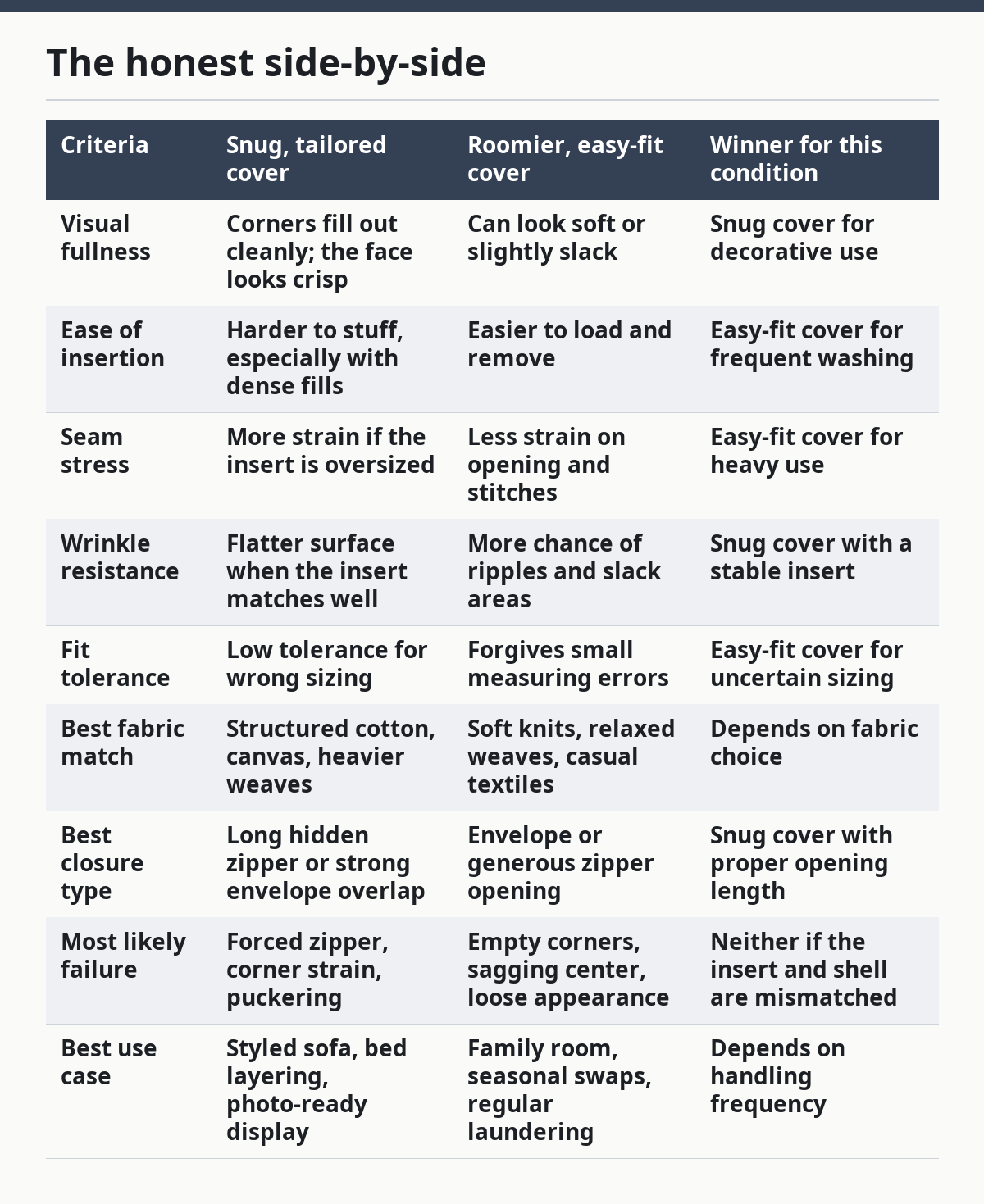
That table is the short version. The longer version is this: if the insert is expensive or hard to replace, buy the cover with more forgiving construction. If the room depends on a polished look, buy the tighter one and make sure the insert is the correct fill density. The wrong combination is a beautiful fabric in the wrong dimension.
Which construction is right for your room?
The right construction depends on whether the cover will be seen, handled, or washed more often. For a formal living room or bedroom, a hidden zipper and a firmer shell usually win. For a casual den, children’s room, or seasonal decor, an envelope closure or slightly easier fit may be the smarter choice.
A hidden zipper is the strongest choice when the front face needs to stay clean. It keeps the back seam discreet and lets the cover sit flat against a sofa or headboard. It also gives the most predictable silhouette, which matters if the room depends on symmetry. The drawback is practical: a hidden zipper can be fussy to close if the insert is thick, and a weak one can fail near the end stops. If the listing does not mention zipper length, I would not assume it is generous.
An envelope closure is the better pick when easy removal matters more than perfect tension. The overlap hides the insert and avoids hardware, which makes the cover simpler to wash and less likely to snag. The downside is that the overlap can shift over time, especially on slick fabrics or with very full inserts. If the back is meant to be hidden, that may not matter. If the cushion rotates or is seen from the back, it can look untidy.
A piped or flanged edge is useful when the insert is a little undersized or the room needs a more tailored decorative frame. It adds definition, but it also adds complexity and, in some cases, a little extra bulk at the seam. That extra bulk can be a problem on very small sizes, where 1/2 inch matters.
The room-specific advice is to choose the construction that solves the actual use case, not the one that sounds fancier. A cover that launders cleanly and stays shut is better than one that has elaborate trim but poor fit.
What should I check before buying a cover?
Check the finished dimensions, the closure opening, the seam finish, and whether the seller states the insert size separately from the cover size. Those four details prevent most fit mistakes before money changes hands.
First, confirm whether the listed measurement is the finished cover size or the insert size it is meant to hold. That distinction causes the most confusion in home textiles. Second, look for a statement about closure type and placement. A 16 x 16-inch cover with a short overlap may fit a thin insert but fail with a plush one. Third, check whether the listing says prewashed, preshrunk, or dry clean only. Fabric that shrinks after washing can turn a correct fit into a tight one. Fourth, read the material description with suspicion if it is vague. A “cotton blend” can behave very differently from a structured 100% cotton shell.
If the seller provides a washing label or care standard, keep it in view. Home textile care guidance from organizations such as the Textile Exchange and the U.S. Federal Trade Commission’s textile labeling rules can help you interpret fiber claims, while general textile care guidance from the American Cleaning Institute gives a better sense of what finishes tolerate laundering. For fabric safety and labeling details, the Federal Trade Commission’s clothing and textile label rules are worth reading: https://www.ftc.gov/business-guidance/resources/threading-your-way-through-labeling-requirements-under-textile-wool-acts. For fabric-care basics, the American Cleaning Institute’s care guidance is a useful reference: https://www.cleaninginstitute.org/cleaning-tips/clothing-care/fabric-care.
The key question is not “Is the cover pretty?” It is “Will the stated construction hold the insert I own, and will it keep that shape after washing?” If the listing cannot answer that, the risk belongs to the buyer.
When does the rule change completely?
The rule changes completely when the insert is very soft, the fabric is highly structured, the cover must be washed often, or the shape is unusual. In those cases, a standard size match can fail even if the numbers look right.
A very soft insert can make a true-size cover look loose. Feather and down-blend inserts can compress and then spring outward, which makes a cover behave differently from a foam or polyester fill. If the insert has little loft, a slightly smaller cover may be the only way to get the corners to look finished. The opposite is also true: a dense insert in a too-small shell can push seams hard enough to distort the shape.
Highly structured fabric changes the equation. A thick jacquard or textured weave can hold shape with less tension, while a soft jersey or loosely woven cotton needs the insert to do more of the work. This is why a size that works in one fabric can fail in another, even on the same cushion shape.
Frequent washing is the third exception. If the cover will be removed every week, ease of use may matter more than the sharpest possible fit. A slightly roomier shell with a durable closure can outperform a stricter one that frays or fights the insert every time it is opened.
Unusual shapes are the final exception. Oversized bolsters, very thin lumbars, and custom-cut cushions often need a pattern adjustment rather than a simple size match. If the cover is for a foam seat pad, a pet bed, or another nonstandard shape, the normal square-cushion rule is the wrong tool.
In short, the standard sizing rule works best for ordinary square and lumbar inserts. It is the wrong tool for very soft fills, unusually rigid fabrics, frequent laundering, and nonstandard shapes.
The verdict: which one to choose and why
Choose the snug, tailored cover if you want a crisp decorative look, a square or lumbar insert with decent loft, and a room where appearance matters more than easy removal. Choose the roomier, easy-fit cover if the insert is soft, the cover will be washed often, or the opening needs to survive repeated handling. Neither if the listing hides the finished dimensions, the closure length, or the insert size it expects, because the fit risk is too high.
That is the plain decision. The snug option wins for display. The easy-fit option wins for convenience. If the insert is already slightly undersized or the fabric is soft and forgiving, a snug cover often gives the better finished look. If the fill is dense or the cover will be handled constantly, the looser construction is the safer choice.
What if the cover still looks wrong?
If the cover still looks wrong, the insert, not the cover, is often the problem. An underfilled insert makes any shell look limp, and an overfilled insert can force seams into odd shapes even when the nominal size is correct.
A quick fix is to swap the insert before assuming the cover is defective. A firmer insert can make the same cover look one size better without changing anything else. If that does not help, the shell may have an opening that is too short, a seam allowance that is too wide, or a fabric that stretches more than the listing suggested. Those are construction problems, not style preferences.
If the problem is only one corner or one edge, the issue may be asymmetry in the insert or uneven seam tension. If the entire cover looks slack, the cover is probably simply too large for the fill. If the zipper bows or the closure feels strained, the cover is probably too small or the opening too short.
The fix is not always to size up or down blindly. It is to identify which part of the construction is causing the shape to fail.
Why does construction matter more than the label?
Construction matters more than the label because two covers with the same nominal size can behave like different products. Fabric weight, seam allowance, and closure length can change the usable space by enough to affect the finished look.
A label says 18 x 18 inches. Construction tells you whether that is a finished size, a cut size, or a nominal size meant to describe the insert. That difference is not minor. It decides whether the corners sit tight, whether the closure closes comfortably, and whether the cover stays smooth after a few uses. In bedding and home decor, the label is a clue; the build is the answer.
That is why the most reliable buying habit is boring but effective: compare the listed size, the closure type, and the fabric description all at once. If one of those three is vague, the fit risk rises. If all three are clear, the chances of a good result improve sharply.
FAQ
Should a pillow cover be smaller than the insert?
Yes, often by a little. A cover that is slightly smaller than the insert usually gives a fuller, cleaner look, especially for decorative squares and lumbars. The exact difference depends on fabric firmness and fill type, but forcing a much larger insert into a too-small cover can strain the seam and zipper.
What happens if the cover is too big?
A cover that is too big looks slack, especially at the corners and center. The insert can shift inside the shell, and the cushion may need constant reshaping. On smooth fabrics, the extra room shows immediately as wrinkles and empty edges.
Is an envelope closure as good as a zipper?
An envelope closure is not as precise, but it is often easier to live with. It works well when you want quick removal and a softer look, while a zipper is better when you need a cleaner, tighter silhouette. The better choice depends on how often the cover will be washed and how visible the back will be.
Do all listed sizes mean finished size?
No. Some listings give the finished cover size, while others describe the insert size the cover is meant to fit. That distinction can change the fit by enough to make a cover look wrong. If the listing does not say clearly which measurement it uses, treat it cautiously.
What’s the biggest mistake people make with cover sizing?
The biggest mistake is matching the label instead of the actual insert. A worn insert can measure smaller than its nominal size, and a very plush insert can measure larger. Measuring the fill you already own tells you far more than the number printed on the package.
Drafted with AI; not yet reviewed by a person.
About the Author