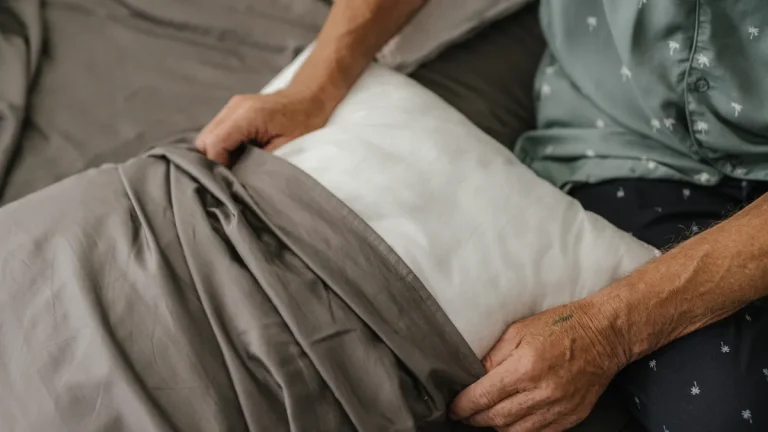
Decorative pillows with tassels and textured covers
Last updated: November 18, 2026
Quick answer: for most homes, pillow cover materials and construction favor cotton with a hidden zipper and reinforced seams, because that combination balances comfort, washability, and everyday durability better than most decorative-only fabrics. In Pillow cover materials and construction — The Complete Guide, the best choice is the one that fits the room, the insert, and the care routine rather than any single “ideal” fabric.
I write about home textiles and soft goods construction, so in Pillow cover materials and construction — The Complete Guide I look at the things that decide real-world performance: fiber content, thread count when it is meaningful, weave, seam type, zipper quality, and whether the cover is meant to be decorative or washed often.
Key takeaways
- Breathable natural fibers feel cooler and softer in daily use, but they can wrinkle, shrink, or wear faster depending on weave and finish.
- Polyester and other synthetic covers usually resist wrinkles and fading better, yet they can feel warmer and less airy than cotton or linen.
- Construction details such as hidden zippers, welted edges, serged seams, and the right insert size matter as much as fabric choice.
- For a living room cushion that gets handled often, durability and easy care matter more than a luxury hand feel.
- For a bed or sofa used mainly for looks, texture and drape may matter more than abrasion resistance.
What actually matters in pillow cover materials and construction?
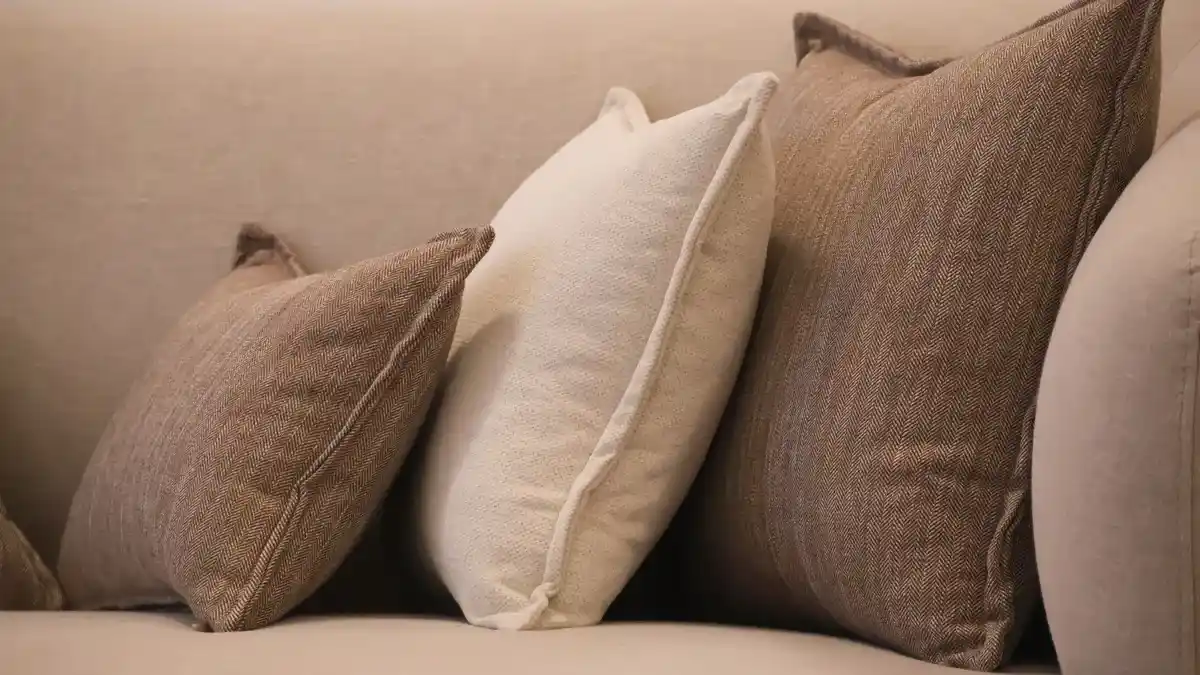
The right cover is the one whose fiber, weave, and construction match the job well enough for the room and use case. A decorative cover that never leaves a guest bed has different needs from a couch cover in a family room, and a lumbar cover used for daily support needs stronger seams than a shams-only accent piece.
Start with fiber. Cotton is versatile, easy to print, and common in percale, sateen, and canvas-like constructions. Linen brings a drier hand, visible slub, and strong drape, but it wrinkles quickly. Silk feels refined and smooth, yet it is sensitive to abrasion, moisture, and aggressive washing. Polyester and polyester blends can mimic several looks at lower cost, and they usually hold color well.
Then look at weave. Percale is crisp and breathable. Sateen is smoother and has more sheen. Twill shows diagonal ribs and tends to hide wear better than plain weave. Bouclé and textured jacquards add depth, but they can snag. Velvet gives a plush surface and stronger light reflection, though pile direction changes the look depending on where the light hits.
Construction decides whether the fabric keeps doing its job after repeated use. A cover with a hidden zipper and clean seam allowance is easier to remove and wash than one with a fragile envelope closure. Double stitching, overlocked edges, and piping can improve edge stability. If the cover is large, a slightly larger insert often helps it look fuller; if it is too tight, the seams strain and the corners flatten.
Two sources are worth keeping in mind here: the Textile Exchange organization tracks fiber and material standards across the supply chain, and the U.S. Federal Trade Commission’s textile rules explain how fiber content and care information should be labeled. If a listing does not state the fiber content clearly, that is a warning sign, not a minor omission.
Cotton covers: a practical all-purpose choice
Cotton is versatile enough that many buyers start there. It breathes, takes dye well, and usually feels familiar from the first touch. For covers that need regular washing, cotton percale and cotton canvas-like weaves are especially practical because they tolerate frequent handling without feeling overly delicate.
The strength of cotton is balance. It can be soft without being fussy, and it works in almost every room style. A 100% cotton cover with a tight weave and a decent zipper can be suitable for daily use on a sofa, bed, or nursery chair, especially when the fabric weight and seam finishing are solid. Cotton also tends to be easier to find in standard sizes such as 18 x 18 inches and 20 x 20 inches.
The weak spot is that cotton is not all the same. A thin cotton cover can become limp, fade faster in bright sun, or wrinkle sharply after washing. Very soft cotton blends may sacrifice durability for hand feel. Lower-quality cotton can also show seam puckering if the stitching is loose or the insert is too oversized. If the product page does not mention weave, weight, or seam finishing, the result can be a cover that looks good in photos and disappoints in use.
Cotton is a dependable pick for someone who wants one fabric that works in many rooms rather than a specialty material. It is also the easiest recommendation for households that wash covers often, rotate seasonal decor, or want a neutral base that can handle patterned throws and mixed furniture styles. It is not the strongest choice if the goal is a highly textured statement piece or a formal, high-sheen look.
Linen covers: best for texture, drape, and a lived-in look

Linen wins when texture is the point. It has an airy, slightly dry hand and a natural slub that gives a room depth without loud patterning. In a relaxed interior, linen reads calm and expensive without needing heavy ornament. It also gets softer with washing, which is why many people choose it for bed layers and sofa accents that are meant to look slightly relaxed rather than perfectly pressed.
The appeal of linen is visual and tactile. It drapes beautifully over an insert, and its irregular surface breaks up light in a way that cotton usually does not. A linen cover in a neutral tone can make a simple cushion look more layered than a smoother fabric of the same color. It is especially effective in larger sizes, where the fabric’s movement is easier to see.
The drawback is maintenance. Linen wrinkles quickly, and some buyers love that while others see it as untidy. It can also feel stiffer than cotton at first, and lower-quality linen may soften unevenly or abrade at high-friction points. If the cover is for a family sofa that gets heavy use, the corners and seams can look tired sooner than a denser cotton or synthetic option. Linen also usually costs more relative to its immediate durability, so the value case depends on whether the look matters more than fuss-free care.
Linen is the right choice for someone who wants texture first and low maintenance second. It is not the best fit if the reader wants a perfectly smooth, always-taut cover or if the room gets rough daily use from pets, children, or constant lounging. For a formal sitting room, a linen front with a sturdier backing can be a smart compromise.
What makes velvet, silk, and other luxe fabrics worth it?
Velvet wins when the goal is depth, light play, and a richer visual finish. Silk wins only when elegance and delicacy are the priority. Both fabrics change the mood of a room instantly, but they do so at the cost of easier care and, often, durability.
Velvet is the more practical of the two. Its pile creates a dense, plush surface that looks substantial on a sofa or bed. Good velvet covers often hold shape well and can make a small cushion feel more finished. They also tend to photograph beautifully because the pile catches light. The trade-off is that velvet can show pressure marks, pet hair, and directional shading. In strong daylight, the nap may look uneven from one angle to another. Some velvets also crush at the fold line if they are stored tightly.
Silk is the most delicate option here. It has a smooth, refined feel and a subtle sheen that other fabrics cannot fully copy. That said, silk is vulnerable to abrasion, sweat, sunlight, and water spotting. A silk cover used daily on a couch is asking for visible wear unless it is treated and handled with care. It is better for decorative use, low-contact pillows, or formal spaces where the cover is not expected to take punishment.
A polyester velvet or velvet-look fabric often makes more sense than real silk for a decorative cushion that still needs to survive regular use. Many synthetic versions are easier to clean and less likely to show permanent marks. For a substantial-looking cushion, velvet is especially effective because the pile adds depth and a soft, rich surface that changes with the light. The reader who should skip these luxe fabrics is the one shopping for a hard-wearing family-room cover or anything likely to be machine washed weekly.
The construction details that separate a good cover from a bad one
A cover can have decent fabric and still fail because of poor construction. That is why the inside matters. Construction decides whether the seams survive repeated stuffing, whether the corners sit cleanly, and whether the opening holds up after a dozen wash cycles.
The first detail to inspect is the closure. A hidden zipper is usually the most practical option for removable covers because it keeps the shape clean and lets the insert come out easily. An envelope closure is simpler and has no hardware, but it can gape if the insert is too full and may shift over time. Buttons can look charming on decorative pieces, though they slow down washing and can become weak points. If a zipper is metal and exposed, it may scratch furniture; if it is too flimsy, it can fail early.
Seams matter just as much. Double-stitched seams and serged raw edges usually last longer than a simple single stitch on cheap fabric. Welted or piped edges give structure and help a cover keep a crisp outline, especially on square forms such as 18 x 18 inches or 22 x 22 inches. A generous seam allowance also helps, because thin allowances can fray or pull when the cover is overstuffed.
Lining is another hidden factor. Some higher-end covers use a lining to improve opacity and reduce stress on the face fabric. That matters for lighter colors and open weaves. Interfacing can also strengthen flaps, edges, and closures. None of this shows in the product photos, which is why a listing that only names the front fabric is incomplete.
If you want the most durable construction, look for a hidden zipper, serged or overlocked seams, and enough seam allowance that the fabric does not strain at the corners. Skip covers that do not state closure type or seam finish if the pillow will be removed and washed often.
How to choose the right pillow cover material for your room
The right choice depends on where the cover will live, how often it will be touched, and whether you care more about texture or easy care. A bedroom accent on a guest bed has different needs from a nursery chair or a sofa in a sunlit family room.
For most living rooms, cotton or a cotton-poly blend is the safest answer. It gives a balanced mix of comfort and cleaning ease. If the room is casual and you want a more textured, layered look, linen makes sense. If the room is formal and the cushion is mostly decorative, velvet or a velvet-look fabric may be the better visual fit.
For high-use family spaces, avoid fragile fabrics and very loose weaves. Twill, canvas, and denser cottons usually survive better than delicate open weaves. For sunny rooms, fabrics with better color retention matter more than the exact hand feel, because fading becomes visible long before a seam fails. For a child’s room or a pet-heavy home, easy-wash construction and a sturdy zipper matter more than luxury texture.
This is also where insert fit matters. A 20 x 20 inch cover on a 20 x 20 inch insert may look flat; an insert slightly larger than the cover often creates a fuller edge. But overstuffing strains seams and shortens the life of weaker fabrics. If the listing does not mention the recommended insert size, that is another sign the construction details may be thin.
For buyers who want the fewest regrets, the practical order is simple: cotton first, linen second if texture matters, velvet third if the room wants drama, and silk only for low-contact decorative use.
The honest side-by-side
Cotton wins for versatility, linen wins for texture, and the better choice depends on whether the reader wants easy care or more character. The table below compares the options that most often get confused.
| Criteria | Cotton | Linen | Winner for [condition] |
|---|---|---|---|
| Breathability | Strong and familiar | Strong, with a drier hand | Cotton for all-day comfort |
| Wrinkle resistance | Moderate, depending on weave | Low | Cotton for neatness |
| Texture and visual depth | Usually smoother | Naturally textured | Linen for relaxed styling |
| Ease of washing | Usually straightforward | Can wrinkle and change feel | Cotton for frequent laundering |
| Durability in daily use | Good when woven tightly | Good, but more dependent on quality | Cotton for heavy handling |
| Formal, dressed-up look | Clean but casual | Relaxed and artisanal | Linen for soft, raised rooms |
| Color and print options | Very broad | Broad, but often more muted | Cotton for pattern-heavy decor |
| Cost-to-versatility value | Usually strong | Usually weaker unless texture is the goal | Cotton for most households |
| Best use case | Everyday covers, mixed-use rooms | Decorative accents, layered interiors | Cotton for function; linen for style |
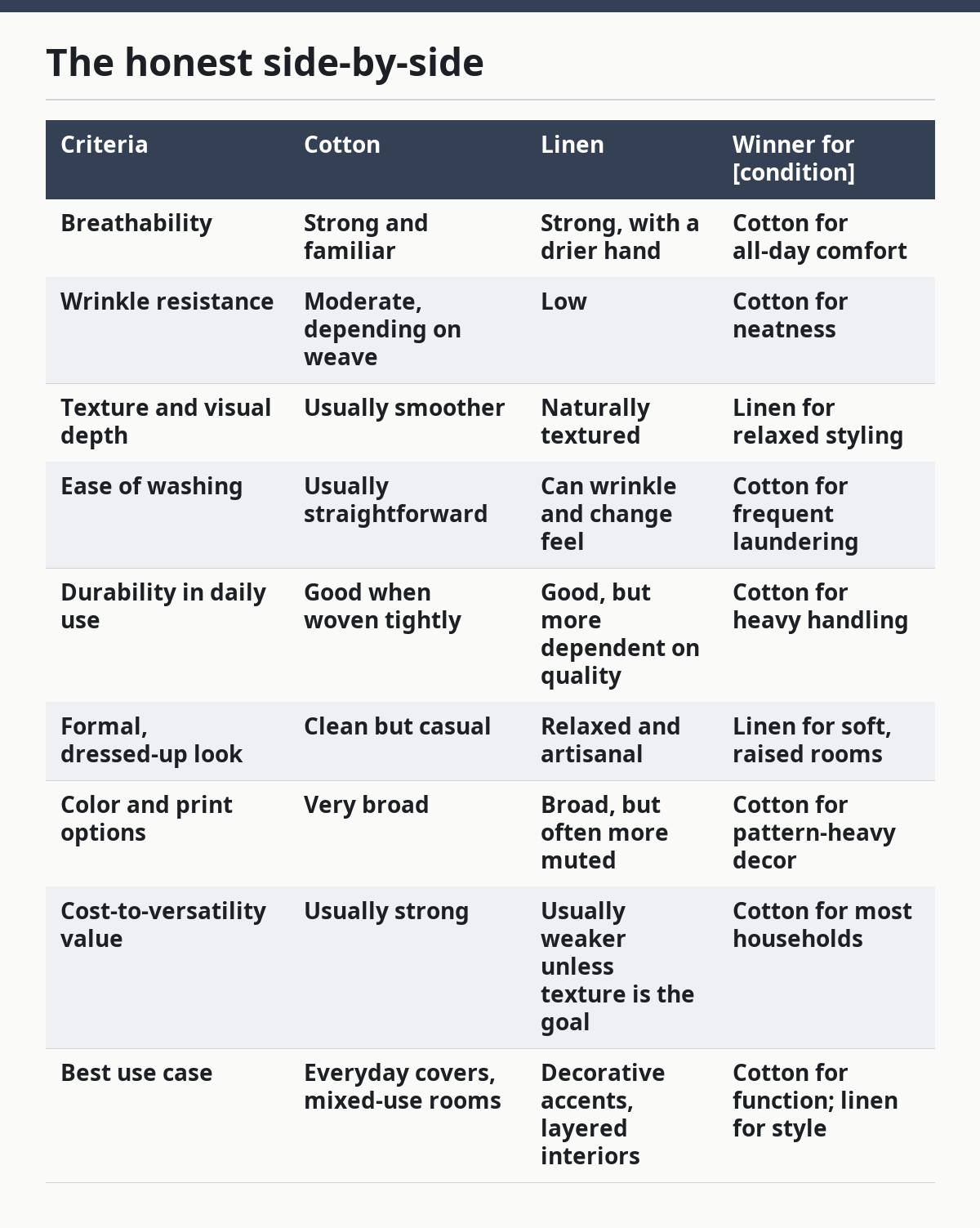
The main takeaway from the comparison is that cotton is the safer buy, while linen is the more expressive one. If the reader wants one cover type that works almost everywhere, cotton usually wins. If the reader wants the cover to be part of the room’s style story, linen earns its place.
When to reconsider the choice entirely
The right answer changes in a few cases, and those exceptions matter more than most general guides admit. A cover choice that works for a standard sofa in a neutral apartment can be wrong for a dog bed, a sunroom, or a high-traffic play space.
First, if the cushion will be handled by children, pets, or frequent guests, construction beats material hype. A durable synthetic blend with a solid zipper and reinforced seams may outperform a prettier natural fiber. This is the point where a soft-looking fabric loses to one that simply lasts longer.
Second, if the room gets strong direct sun for several hours a day, color stability becomes critical. Some fabrics fade faster than others, and dark, saturated colors show the problem sooner. In that case, a well-made cotton or polyester blend in a lighter tone may be smarter than a richly colored luxury textile.
Third, if the insert is unusually large, overfilled, or oddly shaped, the construction needs to accommodate it. A fragile envelope closure or a shallow seam allowance may not survive the strain. Decorative covers that look beautiful on standard square inserts can perform badly on oversized or lumbar forms.
Fourth, if the cover must be washed often at home, avoid materials that need careful handling or that may shrink, distort, or lose finish quickly. A fabric that looks perfect only when dry-cleaned is a poor fit for a household that wants convenience.
These exceptions are why there is no universal “best” fabric. The wrong room, the wrong use case, or the wrong care routine can turn a good-looking cover into a bad purchase within a month.
The verdict: which pillow cover material to choose
Choose cotton if you want the most practical all-purpose material for everyday use, easy washing, and broad style flexibility. Choose linen if you want visible texture, relaxed drape, and a more layered interior look. Neither if the cover will face heavy pet use, harsh sunlight, or frequent washing and the listing does not clearly state fiber content, closure type, and seam construction.
That is the cleanest call. Cotton is the default for most homes. Linen is the style choice when the room can tolerate wrinkling and a softer, lived-in finish. If the cover has vague specs, no seam details, and no clear care instructions, skip it and keep looking.
How do I know if a pillow cover is well made?
A well-made cover usually states its fiber content, closure type, and care instructions clearly. The zipper should sit cleanly, the seams should look straight and reinforced, and the listing should say whether the fabric is lined or has a piped edge. A product that hides these basics is often hiding weaker construction too.
Is linen better than cotton for everyday use?
Cotton is usually better for everyday use because it is easier to wash, less prone to obvious wrinkling, and more forgiving in high-traffic rooms. Linen is better when the look of texture matters more than low maintenance. If the cover will be handled often, cotton is the more practical pick.
Are velvet pillow covers hard to care for?
Velvet can be harder to care for because pile shows pressure marks, shading, and pet hair more easily than flat weaves. Some synthetic velvets are easier than others, but the fabric still asks more of the user than cotton. It is best for decorative use or for spaces where the cover will not be rough-handled.
What closure is best on a removable cover?
A hidden zipper is usually the best closure for a removable cover because it is clean, practical, and easy to take on and off. Envelope closures are simpler and avoid hardware, but they can gap or shift if the insert is too full. Buttons look decorative but are less convenient for frequent washing.
Drafted with AI; not yet reviewed by a person.
About the Author