Round cushion with other sofa pillows
Last updated: November 18, 2026
Key Takeaways
- Fit depends on shape, seam allowance, and insert fullness.
- Round covers usually match the cushion diameter with a little ease.
- Bolster covers fit length and circumference, not just one package number.
- Custom cushions often need tailored covers when standard sizes miss the shape.
Pillow cover sizes for odd shapes are about matching the cover to the form, not forcing a round, bolster, or custom cushion into a square-size chart. In Pillow Cover Sizes for Odd Shapes: Round, Bolster, and Custom Cushions, a round pillow needs diameter-based sizing, a bolster needs length and circumference, and a custom cushion usually needs a tailored cover made to the exact finished dimensions.
What odd-shaped pillow covers need to fit well

Odd-shaped pillow covers need the right shape allowance, not just a label that says “large” or “small.” A 16-inch square insert and a 16-inch round insert do not behave the same inside fabric, and a 24-inch bolster is never solved by guessing from a standard throw cover chart. The fit depends on three things: the finished shape, the seam allowance, and how full the insert is.
The easiest way to think about it is this: a cover should follow the outline of the cushion without pulling at the seams or sagging at the corners. For a round form, that means a true circle with enough ease for the fill. For a bolster, that means a tube with two end pieces and a cylindrical body. For a custom cushion, it means matching the exact dimensions from edge to edge, often with a tailored cover rather than an off-the-shelf size.
This is where standard guides usually stop short. They explain square and rectangular covers, then leave round and cylindrical shapes to trial and error. That wastes time and often leads to a cover that zips, but looks wrong. A round insert inside a cover made too shallow flattens into a puck. A bolster cover that is too tight creates wrinkling along the sides and strain at the ends.
For a quick anchor, think in terms of finished measurement rather than retail size labels. A 20-inch round cushion calls for a 20-inch round cover only if the construction allows a little ease; the same principle applies to a 6-by-18-inch bolster or a made-to-order seat cushion. The cover should complement the volume of the insert, not squeeze it flat.
How do you size a cover for a round pillow?
A round cover usually matches the cushion diameter, with a small amount of ease built into the construction. The number to care about is the finished diameter, not a square-equivalent label, because the shape is what creates the fit.
Round covers are simpler than they first look. If the insert is a true circle, the cover should be cut to that same circle with seam allowance added around the edge. Many round forms are sold by diameter, such as 16, 18, or 20 inches, and those numbers are the right starting point for the cover size. What changes the result is fullness: a very plush insert may need a cover that is fractionally larger in the body so the front face does not dome too hard.
In many cases, the cover can be made as two circles joined around the edge or as a circular front with a matching back panel. A zipper or envelope opening usually sits on the back, where it will not interrupt the shape. If the insert is feather-filled and compressible, a close fit often looks better. If the insert is foam or a denser fill, a little extra room helps the edges sit cleanly.
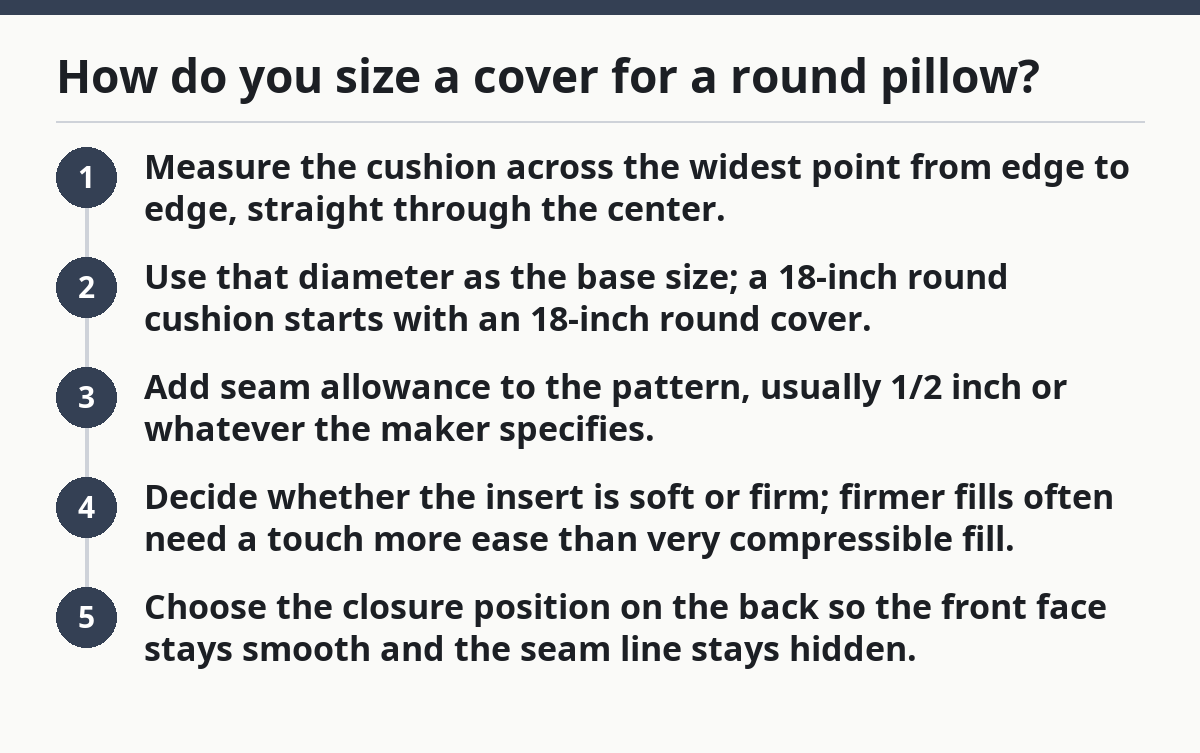
Here is a practical procedure for round sizing:
- Measure the cushion across the widest point from edge to edge, straight through the center.
- Use that diameter as the base size; a 18-inch round cushion starts with an 18-inch round cover.
- Add seam allowance to the pattern, usually 1/2 inch or whatever the maker specifies.
- Decide whether the insert is soft or firm; firmer fills often need a touch more ease than very compressible fill.
- Choose the closure position on the back so the front face stays smooth and the seam line stays hidden.
A common mistake is sizing a round form like a square insert and then expecting the corners to disappear. There are no corners to hide, so extra slack just creates a loose rim. Another mistake is buying a cover based only on the retail label without checking whether it is meant for a stuffed disc, a corded round cushion, or a flatter decorative form. If the listing names a diameter and a construction style, that is the detail that matters.
For specialty sizing, round covers are the easiest place to go custom when the insert is an odd thickness. A tailored cover can preserve the clean circular outline better than a near-match standard size.
What size cover fits a bolster pillow?
A bolster cover fits the bolster’s length and body circumference, not just one number on a package. The size you need is the tube length plus the diameter of the round ends, and the fit depends on whether the bolster is decorative, supportive, or both.
Bolsters are the shape most likely to confuse a standard size chart. They are long cylinders, often used on beds, benches, or window seats, and they need a cover that follows the tube without twisting. A cover for a 6-by-18-inch bolster, for example, is built around a 6-inch diameter body and an 18-inch length, with end caps that close the cylinder. A 4-by-24-inch bolster needs a longer side panel and a different amount of stretch across the ends.
The key number here is diameter, because it controls how tight the side seam will feel. A larger diameter increases the circumference dramatically, so the fabric around the body must be cut with that in mind. That is why a bolster cover cannot usually be substituted with a square or euro-style cover and expect a tidy result. The ends will pull, the center will sag, or both.
For the cleanest fit, the pattern should account for three parts: the cylindrical middle, two circular ends, and the seam allowance around each piece. Many bolster covers also need a longer zipper opening than a simple square cover, because stuffing and removing the insert through a short opening is awkward. If the bolster is firm, a hidden zipper along the back seam is often the most practical choice.
This shape is not for someone who wants a one-size-fits-all solution. If the insert is handmade, overstuffed, or slightly irregular, a standard bolster cover may still look wrong even if the stated dimensions are close. That is when a tailored cover earns its keep. A custom cut can correct slight asymmetry and keep the ends from puckering.
The trade-off is time and cost, which is why a custom bolster cover makes more sense for a visible bed layer or built-in banquette than for a casual accent piece tucked behind other cushions. If the bolster is mostly decorative, an approximate match may be acceptable. If it is meant to support the neck or back, the fit matters more.
When a custom cushion needs a tailored cover
A custom cushion needs a tailored cover when the shape, depth, or edge construction does not fit a standard size chart. The cover should be made to the finished dimensions of the insert, especially when the cushion is trapezoid, wedge-shaped, deeply boxed, or built for a bench, bay window, or booth.
Custom cushions are where generic sizing breaks down fastest. The insert may be 22 by 17 inches at the top, 20 by 15 inches at the base, and 4 inches deep. That is not a standard throw size, and forcing it into one creates stretched seams and a sloppy face. A tailored cover solves that by matching the exact panel shapes and seam lines of the cushion itself.
The practical rule is simple: if the cushion has nonstandard angles, a curved front, a boxed edge, or a depth that changes how the fabric sits, it deserves a cover patterned to that geometry. The cover may still use familiar elements such as a zipper, piping, or an overlap back, but the measurements are the point. This is where specialty sizing is not a luxury; it is the difference between a fit that works and one that misses the shape entirely.
Custom work also helps when the cushion is built into furniture. A banquette seat, a camper cushion, or a window seat can have slight irregularities from wall to wall. In those cases, even a difference of 1/2 inch can show at the edge or leave a gap at the corner. A tailored cover can hide those inconsistencies and keep the lines clean.
This is not the right path if the cushion is a simple standard rectangle and you just want a quick replacement. A tailored cover takes more planning, more pattern work, and usually more money than a ready-made option. But for a custom cushion, those extra steps are part of the fit, not decoration.
If you need a broader overview of fit, the hub on pillow cover fit covers the larger sizing logic without repeating the shape-specific details here.
The shape-matching rules that prevent bad fit
The best cover is the one that matches the cushion’s geometry, not just its name. Round forms need circular symmetry, bolsters need diameter and length control, and custom cushions need panel-by-panel accuracy.
Three shape-matching rules matter most:
- A circle stays round only when the cover front and back are cut as true circles.
- A cylinder stays smooth only when the side panel length matches the bolster circumference.
- A custom form stays neat only when each face, corner, and side is cut for that exact shape.
The most common failure is mixing shapes. A near-match cover may zip closed, but it can distort the insert in ways that show immediately. On a round piece, the edge may ripple. On a bolster, the ends may look pinched. On a custom seat cushion, the corners may pull diagonally and expose the seam line.
Fabric choice also changes the result. A fabric with little give demands more accurate sizing than a slightly flexible textile. A very structured cover will show small errors more readily than a soft, drapey one. That is why two covers with the same nominal measurements can fit differently. Construction matters as much as dimensions.
If the cushion is decorative, a slightly relaxed fit may be fine. If it needs to look tailored, especially on visible furniture, the pattern should be exact enough that the cover follows the shape without strain. That is where a tailored cover pays off: it gives the finished piece a clean outline instead of a “close enough” look.
Common sizing mistakes with odd shapes
The most expensive mistake is assuming one number is enough. A round cushion, a bolster, and a custom seat each need different information, and skipping one dimension usually means remaking the cover.
The first mistake is using a square-size shortcut for an odd shape. That works poorly because a 20-inch square cover and a 20-inch round cover solve different geometry. The cost is obvious: extra fabric bunches at the edges, and the insert never settles correctly.
The second mistake is ignoring thickness. A cushion with a 4-inch depth and one with a 7-inch depth may share a face measurement, but they do not behave the same in a cover. Deeper forms need more body room, especially if the fill is firm.
The third mistake is forgetting about closure placement. On a round piece, a poorly placed zipper can interrupt the circle. On a bolster, a short opening can make insertion miserable. On a custom cushion, a closure in the wrong seam can break the visual line across the furniture.
The fourth mistake is buying to the label instead of the finished measurement. “Small bolster” or “large round” can mean different things across makers. If the listing does not state the exact dimensions, that cover is a guess, not a match.
The fix is straightforward: choose by shape first, then by finished measurement, then by construction detail. That order saves time and avoids the false economy of a cheap near-fit. A cover that is 1 inch off on a visible custom cushion can look wrong every day for years. That is not a small error on a sofa, bench, or bed.
Choosing standard, specialty, or custom sizing
Standard sizing is fine only when the odd shape is truly standard in its own category. Round and bolster covers often have repeatable dimensions, but custom cushions usually do not.
The decision comes down to how visible the piece is and how exact the fit needs to be. A decorative 16-inch round accent cushion can usually use a standard round cover if the diameter lines up. A 6-by-18-inch bolster may also work with a listed bolster cover if the dimensions are explicit. A built-in window seat almost always needs a tailored cover, because the shape is tied to the furniture itself.
Standard sizing is faster and easier to replace. Specialty sizing gives you more shape-specific options, such as a corded bolster or a round cover with piping. Custom sizing gives you control over every panel, seam, and closure. The trade-off is time and complexity. The more unusual the shape, the less likely a standard chart will solve it cleanly.
One practical way to decide is to ask whether the cushion can tolerate a little looseness. If yes, a standard specialty size may be enough. If no, the cover should be made for the exact finished shape. That is especially true for custom cushions with angled fronts, curved corners, or uneven depths.
For a reader shopping across options, use standard only when the shape is common and the dimensions are clearly listed; use tailored when the shape is distinctive or the furniture demands a precise line. That approach avoids the most frustrating outcome, which is a cover that almost fits but never looks right.
How do you size a cover for a round pillow?
A round pillow cover is sized by diameter, not by a square measurement. The cover should match the cushion’s widest point, with seam allowance added to the pattern and a little ease if the fill is firm.
What size cover fits a bolster pillow?
A bolster pillow fits a cover that matches both its length and its diameter. A common example is a 6-by-18-inch bolster, where the cover must account for the 6-inch tube body and the 18-inch span from end to end.
Can custom cushions use standard covers?
Custom cushions can use standard covers only when the finished shape happens to match a specialty size very closely. Most custom cushions need a tailored cover because the dimensions, angles, or depth are not built around a stock pattern.
Drafted with AI; not yet reviewed by a person.
About the Author