Handmade vs Mass-Produced Pillow Covers
Last updated: November 19, 2026
Quick Answer: In 2026, the cleaner choice is usually handmade vs mass-produced pillow covers based on fit: handmade wins for one-off or odd inserts, while mass-produced wins for repeatable sizing and easier replacement. The right choice depends on how exact the fit must be, how much variation you can accept, and whether you want a custom pillow cover or a factory-made construction.
Key takeaways
- Handmade works best when the pillow shape is unusual, like a V shaped pillow or a cover with a specific closure length.
- Mass-produced pieces are usually easier to compare because the sizing, seams, and closures repeat from one unit to the next.
- Custom options are stronger on handmade pieces, but consistency is stronger on factory-made construction.
- If the cover will be washed often or bought as a spare, the safer choice is usually the mass-produced route.
- If the pillow has an awkward shape or needs a specific fabric weight, handmade is usually the better match.
What actually changes between handmade and factory-made?
Overall, the real difference is control versus consistency. Handmade pillow covers usually give more control over fabric, edge finish, and custom dimensions, while mass-produced pillow covers usually give tighter repeatability across size, seam placement, and closure style. That difference matters more than the label on the listing.
For example, a handmade piece can be cut for a nonstandard insert and can be adjusted for a longer zipper, a hidden envelope back, or a deeper gusset. A factory-made construction is more likely to follow a fixed pattern, such as a standard square or lumbar size, with the same seam allowance every time. For a buyer comparing production method, that means handmade often solves a fit problem, while mass-produced often solves a replacement problem.
So the simplest way to judge the two is this: handmade is about tailoring, and mass-produced is about duplication. If the pillow insert is unusual, tailoring wins. If the goal is to buy one now and another later that looks the same, duplication wins. That is why the subject is not really “which is better,” but “which weakness can the buyer live with.”
How do handmade and mass-produced pillow covers compare?
Therefore, the side-by-side view is often the clearest way to see where the trade-offs land. This table focuses on the factors that change the choice, not on style alone.
| Criteria | Handmade pillow covers | Mass-produced pillow covers | Winner for which condition |
|---|---|---|---|
| Fit consistency | Can be matched to a specific insert, but small variation is possible | Usually more repeatable from piece to piece | Mass-produced, when exact repeat ordering matters |
| Stitching consistency | Depends on the maker and can vary by item | Usually more uniform because the process is standardized | Mass-produced, for predictable seams |
| Custom options | Strong for special sizes, closures, and details | Usually limited to set patterns and set sizes | Handmade, for unusual dimensions |
| Production details | More room for custom edge finish, lining, and zipper placement | More fixed construction choices | Handmade, when details matter more than speed |
| Replacement ease | Harder to match later if the maker changes fabric or batch | Easier to replace with the same style | Mass-produced, for backups and sets |
| Shape handling | Better for awkward forms and nonstandard inserts | Better for common square and lumbar sizes | Handmade, for a V shaped pillow or odd insert |
| Visual uniformity in a set | Can vary slightly from one piece to another | Usually easier to keep identical across a set | Mass-produced, for matched rooms |
| Batch-to-batch sameness | Not guaranteed | Usually the whole point of factory-made construction | Mass-produced, for long-term consistency |
| Ordering risk | More uncertainty if the maker’s process is not spelled out | Less uncertainty when the size chart is fixed | Mass-produced, for low-drama buying |
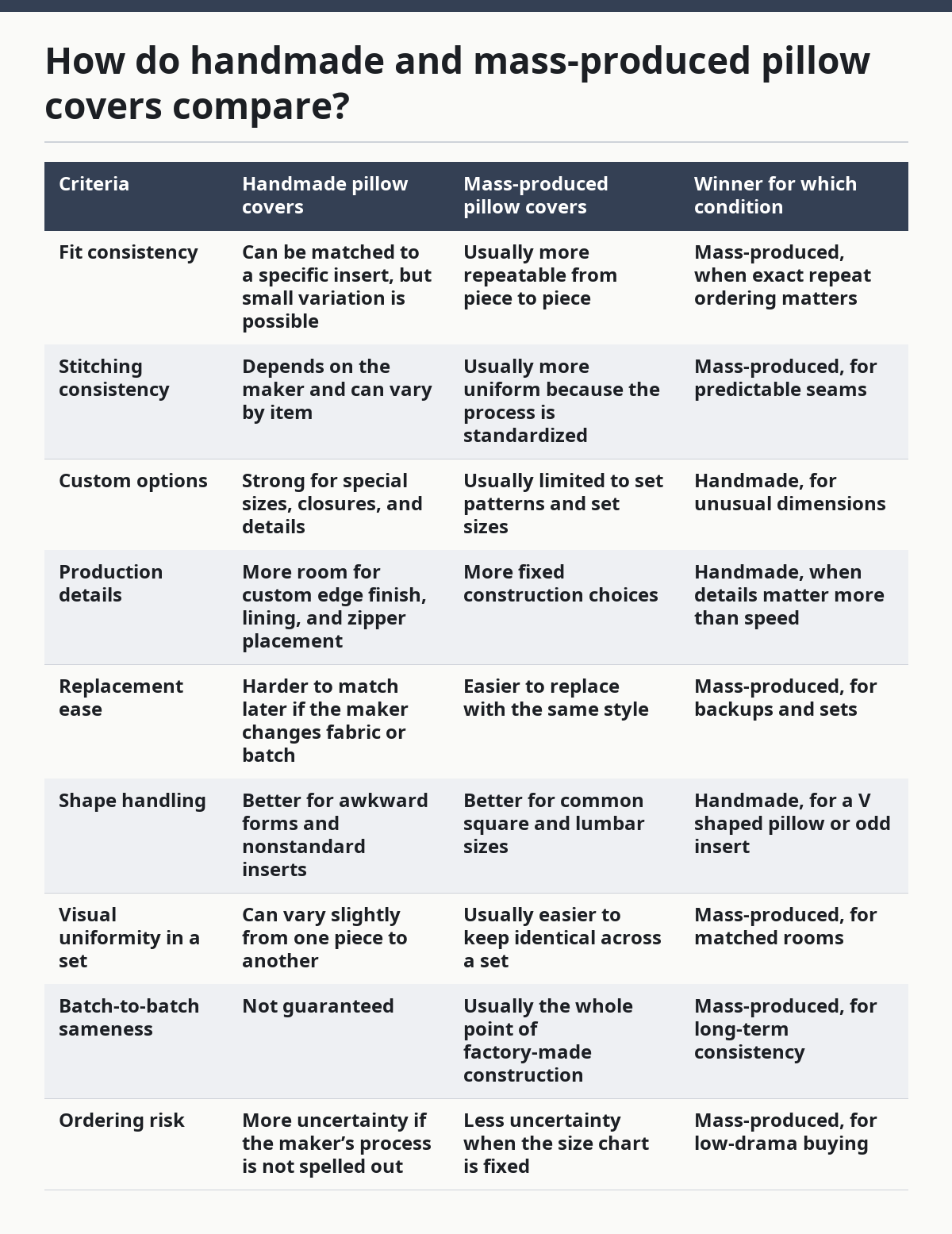
So the table points to the main truth: handmade is better at solving a specific problem, while mass-produced is better at reducing surprise. That is the core decision.
When does a handmade pillow cover win?
Handmade pillow covers win when the buyer needs a better fit than a factory pattern can usually offer. That is especially true for an unusual shape, a deep insert, or a custom pillow cover that must match a room exactly. In those cases, a maker can cut to the dimensions instead of forcing the insert into a standard pattern.
Meanwhile, handmade also wins when the buyer cares about specific details that are often fixed in factory-made construction. A different zipper placement, a hidden closure, a certain seam style, or a fabric with a heavier hand can be part of the brief. The strength here is control. The weakness is that control can come with variation, because handmade work is not built to the same duplication standard as mass production.
That trade-off matters. A handmade piece can look more thoughtful, but it can also be harder to reorder later if the fabric bolt changes or the maker adjusts the method. A buyer who needs four identical pieces for a sofa set may find that slight differences become visible from across the room. Handmade is not the safer option for someone who needs exact matching.
Therefore, a handmade pillow cover is the right call for a person who has a nonstandard insert, wants specific materials, or values custom options more than perfect repeatability. It is the wrong call for a buyer who wants a quick spare, a matched pair, or a replacement that is likely to look the same next season.
When does a mass-produced pillow cover win?
Mass-produced pillow covers win when the buyer wants consistency, easy comparison, and a straightforward replacement path. Factory-made construction usually follows a set pattern, so the buyer is less likely to get one piece with a slightly different seam line or closure size. That matters when the goal is to buy two, four, or more pieces that need to match.
In particular, mass-produced options also usually make the decision easier because the sizes are fixed. A standard square or lumbar format can be compared quickly against the insert, and the buyer can check whether the listed dimensions are close enough. That predictability is useful for anyone shopping for a set rather than a one-off piece.
The weakness is that the fixed pattern can be limiting. If the insert is unusual, the fit can look off even when the listing looks right on paper. Mass-produced options also tend to be less flexible about fabric weight, seam detail, and closure changes. If the buyer needs a specific production detail, the catalog may not offer it.
On the other hand, this option is best for someone who values repeat ordering, room symmetry, and lower decision friction. It is not the best choice for a buyer who needs a special shape or a custom pillow cover that solves a specific fit problem. The whole point of mass production is sameness, and that sameness is a drawback when the pillow is not standard.
What should you inspect before choosing?
Before buying, the buyer should inspect the construction details that affect fit and durability, not just the front fabric. A 1 cm seam allowance, a 20 in x 20 in stated size, or a hidden zipper on the back can matter more than the print. The same is true of closure style, because a zipper and an envelope back wear differently over time.
Since this is where production method shows up in the listing language, handmade listings often describe the method, the finishing steps, and the custom dimensions more openly, while factory-made listings often lean on size charts and batch consistency. If the page says very little about construction, that is useful information too. A buyer should treat missing detail as a warning sign, not as proof that everything is fine, and if the pillow supports sleep, pain relief, or another health need, the buyer should also consult a qualified clinician or the seller before ordering. The American Association of Textile Chemists and Colorists publishes test methods and terminology for fabric performance, and ASTM International maintains textile and material standards that help explain why seam strength, shrink behavior, and dimensional consistency matter in textile products.
Specifically, a good comparison usually comes back to the same question: does the cover need to fit one insert perfectly, or does it need to match several other pieces every time? If the answer is the first, handmade has the edge. If the answer is the second, mass-produced is usually the safer bet. For general sizing and consumer guidance, see the ASTM International standards catalog, the AATCC methods overview, and the pillow cover size guide.
What is the honest side-by-side verdict?
Overall, the honest verdict is that handmade wins on flexibility and mass-produced wins on repeatability. That sounds simple because it is simple. The hard part is knowing which weakness is less costly: the possibility of slight variation, or the limitation of a fixed pattern.
Handmade pillow covers: strengths and weaknesses
Handmade pillow covers are strong when the buyer wants a specific result. They can be made for unusual shapes, adjusted for a custom pillow cover, and finished with details that a standard factory line may not offer. For a V shaped pillow or another odd insert, that flexibility can be the difference between a clean fit and a sloppy one.
However, the weakness is inconsistency. A handmade piece may vary in stitch line, size, or closure placement, and that variation can matter if the buyer wants a matched set. Reordering later can also be harder if the maker changes fabric or production details. Handmade is not the better choice when the main goal is uniformity.
Mass-produced pillow covers: strengths and weaknesses
Mass-produced pillow covers are strong when the buyer wants the same result again and again. Factory-made construction usually gives better size consistency, easier replacement, and less guesswork when buying more than one. That makes it a practical choice for a sofa set, spare covers, or a room where symmetry matters.
By contrast, the weakness is flexibility. Standard sizes and fixed construction can leave an awkward gap, a tight corner, or a poor drape if the insert is not standard. A buyer who needs a special dimension may find the catalog options too rigid. Mass production is efficient, but it is not built for one-off problems.
Who should choose which one?
Choose **handmade** if the insert is nonstandard, the fit has to be exact, or the buyer wants a custom pillow cover with specific fabric or closure details. Choose **mass-produced** if the buyer wants a replacement, a matching set, or a factory-made construction that is easier to reorder later. Neither is right if the buyer needs a perfect fit but is relying on vague sizing only.
Ultimately, the strongest recommendation is this: buy handmade for shape problems, and buy mass-produced for consistency problems. That is the cleanest way to think about it. A handmade piece can solve a fit headache. A mass-produced piece can remove a matching headache.
If the pillow is a standard square and the buyer only wants dependable spares, custom work adds cost and uncertainty without adding much value. If the pillow is unusual and the buyer is trying to force a standard cover onto it, factory sameness becomes a problem instead of a benefit.
When should you change the plan?
Then the choice flips in a few specific cases. If the buyer needs several identical pieces for a visible set, mass-produced wins even if handmade seems more appealing. Matching is harder to protect by hand, especially across more than one order.
After that, if the insert is unusual but the buyer does not care about exact appearance, a mass-produced option can still work as a temporary fix. That is common when the priority is to cover the insert now and refine the room later. In that case, the cheaper decision is not always the smarter one, but it may be the practical one.
Next, if the listing does not clearly state size, closure type, or seam details, the safer move is to step back. A vague description makes both methods harder to judge, but it is especially risky with handmade pieces, where the final result depends more on the maker’s process. A clear 18 in or 20 in size is useful; a fuzzy “fits most inserts” claim is not.
Finally, if the buyer is only comparing style and not production method, the choice is incomplete. The same fabric can behave very differently depending on whether it came from a maker or a factory line. Production method changes fit, repeatability, and replacement risk, which is why it deserves its own comparison before any purchase.
Overall, the bottom line is plain. Choose handmade when the pillow is odd-shaped, custom, or hard to fit. Choose mass-produced when the goal is sameness, easy replacement, and lower uncertainty. Neither if the listing does not give enough construction detail to judge fit.
Drafted with AI; not yet reviewed by a person.
About the Author