
Person organizing folded linens on closet shelves
Last updated: November 19, 2026
Quick answer: Fold pillow covers into flat rectangles in 1 minute or less, then store them in drawers, on shelves, or in bins that match the stack size. Pillow covers bunch up fast, and a bad fold wastes drawer space. How to Fold Pillow Covers for Drawer, Shelf, and Linen Closet Storage is about making flat, stackable rectangles that match your storage spot. The steps below show a practical fold for drawers, shelves, and linen closets.
The fastest fold for pillow covers
A fast fold for pillow covers is a clean third-by-third fold that makes a rectangle close to the size of the cover’s finished face. Picture this: you’re standing at a dresser with a stack of covers, and you need each one to sit flat in a drawer or on a shelf without sliding apart.
Start with the cover front side down on a table. Smooth the seams with your palms, fold one side toward the center, then fold the other side over it, and finish by folding the long rectangle in half or in thirds depending on the size.
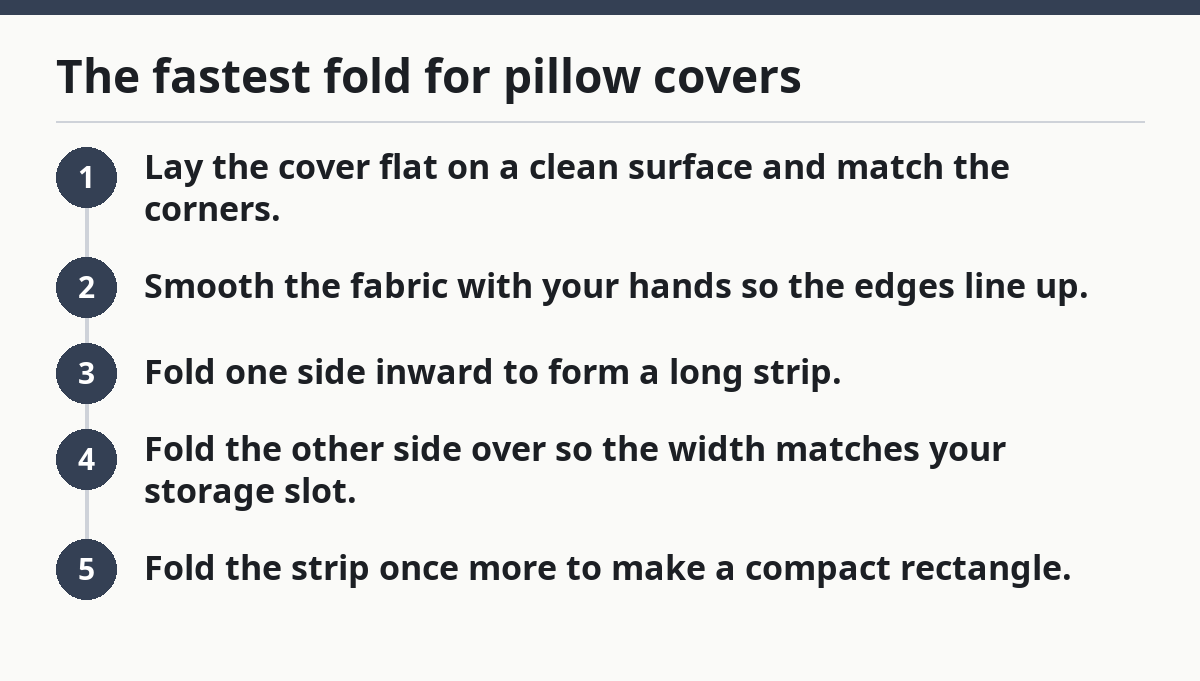
- Lay the cover flat on a clean surface and match the corners.
- Smooth the fabric with your hands so the edges line up.
- Fold one side inward to form a long strip.
- Fold the other side over so the width matches your storage slot.
- Fold the strip once more to make a compact rectangle.
That gives you a shape that stacks well in a drawer divider and still opens without a fight. The neat trick is to keep the edges square, not rounded. Rounded folds waste space.
This fold works for most standard pillow covers, even when the fabric is soft cotton, linen, or a cotton blend. If the cover has a flap closure, tuck the flap inside before the final fold so it does not curl out and snag the stack.
How do you fold pillow covers for a drawer?

You fold pillow covers for a drawer into a low rectangle that matches the drawer’s depth, then stack the folds on edge instead of laying them loose. Picture this: you’re opening a shallow drawer with drawer dividers, and the goal is to see every set without digging through a pile.
A drawer needs a fold that stays compact and does not spring open. For a 6-inch-deep drawer, a flatter fold usually works better than a bulky bundle, because a tall stack crushes the covers at the bottom and makes the top pile slide.
- Measure the drawer height so you know how tall the stack can be.
- Fold the cover into a long strip with the seams tucked in.
- Fold again to a rectangle that is about as wide as the divider slot.
- Stand or lay the rectangle flat depending on the drawer depth.
- Keep matching sets together so one grab gives you a full set.
Drawer dividers help more than most people expect. They stop small stacks from drifting into one another, and they make it easier to label one section for shams, one for everyday pillow covers, and one for guest bedding.
On the flip side, don’t stuff a drawer until the fabric bulges. Tight compression makes creases harder to remove later, and the stack looks messy after a few uses. If the drawer is packed already, use a thinner fold and leave a little breathing room.
How should pillow covers sit on linen closet shelves?
Pillow covers should sit on linen closet shelves in short, even stacks with the folded edge facing out. Picture this: you’re reaching into a linen closet with three shelves, and you want each set to stay visible, tidy, and easy to pull without toppling the stack.
Shelves reward a slightly wider fold than drawers. A cover folded to a neat square or soft rectangle makes the stack stable, especially if you group by size. Use the shelf front like a display edge, not a dumping zone.
Keep these habits in place:
- Stack by size or room so the covers you use most stay easiest to reach.
- Put heavier or thicker covers on the lower shelf.
- Leave a few inches of open space above each stack so the top cover does not curl.
- Use acid-free tissue paper between delicate covers if the fabric creases easily.
Acid-free tissue paper matters when the fabric is fine, lightly woven, or prone to sharp fold marks. Slip one sheet inside the fold, not around the whole stack, so the paper cushions the crease without turning the pile bulky.
The truth is, shelves look neat only when each stack has the same footprint. If one folded cover is much wider than the others, it pushes the pile out of line and makes the whole shelf look crowded. Keep the fold size consistent across a set.
What fold works best for matching sets?
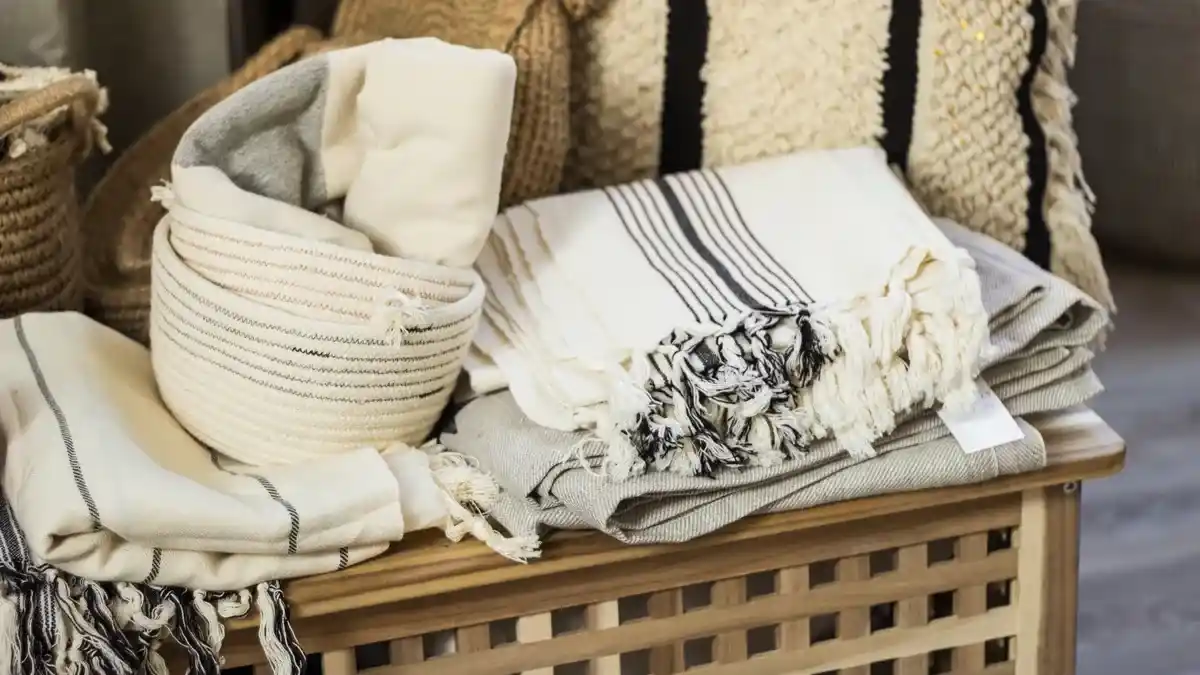
A repeatable fold is the safest choice for matching sets, with the pieces nested together before storage. Picture this: you’re holding a pillow cover and its matching pair, and you want the set to come out as a unit instead of hunting for the second half later.
Matching sets get lost when each piece is folded differently. One cover becomes a tight packet, another stays loose, and the drawer turns into a jumble. A repeatable fold solves that in a simple way.
- Fold each cover the same way so the rectangles match.
- Stack the pair together with the front sides facing in.
- Slip a label card between the pieces or on top of the set.
- Store the set upright in a divider or small bin.
- Keep one set per stack if the closet is crowded.
Labeling sets helps when you own several near-identical covers in white, ivory, or off-white. A small tag with the size, room, or season keeps you from opening three stacks to find one pair. If you use storage bins, put the label on the front edge where you can read it without lifting the lid.
The drawback of mixing sets in one pile is simple: it slows you down every single time. If the covers belong together, keep them together from the first fold to the last shelf.
How do you keep pillow covers from looking wrinkled in storage?
You keep pillow covers from looking wrinkled in storage by using a flat fold, avoiding overstuffed spaces, and never bending the fabric around hard edges. Picture this: you’re opening a bin months later, and you want a cover that still looks smooth enough to use without a long re-fold.
Deep creases come from pressure points. A tight rubber band, a sharp fold over a thick seam, or a bin that is jammed to the top all leave marks. A softer fold with one or two broad turns usually leaves a better result than a tiny packet.
- Fold along natural seam lines when you can.
- Place acid-free tissue paper inside delicate covers.
- Avoid stacking heavy items on top of pillow covers.
- Store in a bin that fits the pile without crushing it.
Storage bins are useful when the closet shelf is deep or the drawer is too shallow for a standing stack. Pick a bin that lets the covers lie flat or stand loosely, not one that forces them into a tight curve.
A common mistake is trying to make every cover the same tiny size. That sounds tidy, but it often creates thick corners and sharp folds. A smarter fold is clean and moderate, not squeezed.
Drawer dividers, shelves, or bins: which layout fits best?
Drawer dividers, linen closet shelves, and storage bins each fit a different kind of pillow cover pile. Picture this: you’re trying to choose between a drawer, a shelf, or a bin, and the real question is how often you need to grab the covers and how much room you have.
Drawer dividers are best when you want fast access and small, separate groups. Shelves are best when you keep larger stacks in view. Storage bins work best when the closet has extra depth or you need one container for guest sets, seasonal covers, or backup pieces.
Use this rough match:
- Drawer dividers for daily-use covers and labeled sets.
- Linen closet shelves for visible stacks you reach for less often.
- Storage bins for overflow, seasonal storage, or mixed sizes.
The simplest rule is the storage layout that matches how often you use the covers. If you reach for them every week, keep them near the front in a drawer or on a shelf. If you use them less often, a bin can keep the stack together without taking over prime space.
One honest limitation: bins are not ideal if you want instant visibility. A lid hides the stack, and a deep bin can turn one neat fold into a buried pile. That is fine for backup covers. It is not the right pick for everyday sets.
Common folding mistakes that waste space
The most common folding mistakes are uneven edges, bulky corners, and mixed-size stacks that don’t sit flush. Picture this: you’re halfway through folding and the pile already looks messy, even though the covers are clean and ready to store.
A sloppy fold costs you space first. Then it costs time every time you dig through the stack. The fix is usually simple, but it has to be consistent.
Watch for these problems:
- Leaving the flap out so it curls and breaks the stack.
- Folding over thick seams instead of flattening them first.
- Making each cover a different size even when the storage space is the same.
- Packing the stack too tightly so the bottom covers crumple.
The most useful correction is boring and effective: fold every pillow cover the same way, then store that same shape in the same place. That keeps the stack from shifting and makes the drawer or shelf easier to maintain.
If the cover is large, don’t force it into a tiny packet just to save an inch. A slightly larger rectangle that lies flat is better than a compressed bundle that pops open later.
How to keep the fold organized over time
You keep the fold organized over time by resetting the stack after each use and returning the cover to the same slot. Picture this: you’ve just washed or changed the bedding, and if you don’t put the cover back the same way, the whole system falls apart by next month.
A storage system only works if the return step is easy. That means your fold should take less than a minute and fit the same space every time. If the fold is too fussy, you won’t keep it up.
- Return each cover to its set before it goes into storage.
- Refold the same way if the edges have shifted.
- Place the stack in the same divider, shelf spot, or bin every time.
- Check the top cover monthly for slipped corners or bulging folds.
This is also where labels earn their keep. A simple label with room names, sizes, or seasons keeps the stack from drifting into the wrong zone. It is a small habit, but it saves real time when you are trying to find one clean cover on a busy day.
For more care guidance beyond folding, the hub on pillow cover care and maintenance can help with the rest of the routine without crowding this page.
How do you fold pillow covers without creasing them?
Fold them on a flat surface, keep the seams aligned, and avoid tight pressure points. The cleanest result comes from broad folds rather than tiny bends. If the fabric is delicate, slip in acid-free tissue paper and store the cover in a space that does not crush the stack.
Should pillow covers be folded or rolled for storage?
Folding is better for drawers, shelves, and most linen closets. Rolling wastes more shape on rectangular spaces and can make the stack wobble or unroll inside a bin. A flat fold also makes it easier to group matching sets and label them clearly.
How do you store pillow covers with matching sets?
Fold each piece the same way, then keep the matching pieces together as one unit. Label the set before you put it on a shelf, in a drawer divider, or inside a storage bin. That way, the pair comes out together instead of getting split across the closet.
Key Takeaways
- A flat, even fold beats a tight bundle for most pillow covers.
- Drawer dividers work best for small, labeled groups you use often.
- Linen closet shelves favor short, stable stacks with open space above them.
- Acid-free tissue paper helps delicate fabric keep a softer crease.
- Matching sets stay easier to find when every piece is folded the same way.
Drafted with AI; not yet reviewed by a person.
About the Author