V Pillow Use and Care: The Complete Guide
Last updated: November 29, 2026
Quick answer: for most people, a V pillow works best when the point supports the neck or knees and the arms support the shoulders, back, or thighs; care usually means washing the cover often, following the label, and drying the filling fully before reuse. This V Pillow Use and Care: The Complete Guide focuses on shape, support, and cleaning rather than product hype. It suits people who want one cushion for sitting up, side support, or leg support; if you need a flat, low-profile sleep surface, a regular pillow is usually the better fit.
A practical guide like this depends on sleep posture, filling type, and fabric care, not product hype.
Key takeaways
- A V pillow works best when the point sits where the body needs less bulk and the wider arms support the sides.
- The removable cover usually needs more frequent washing than the inner fill.
- Drying matters as much as washing; damp filling can stay clumped or start to smell.
- A V pillow is useful for reading, pregnancy support, and postural comfort, but it is not a cure for pain.
- The main mistake is treating it like a normal pillow and folding or crushing it out of shape; if pain, numbness, or breathing issues are involved, it is safer to check with a clinician before relying on any pillow for support.
How do I use a V pillow?
A V pillow works when the point and the two arms match the part of the body that needs support. For most people, the narrow point sits behind the neck or between the legs, while the wider arms cradle the shoulders, back, or knees. That shape is the whole reason to choose it over a plain rectangular cushion.
For sitting up in bed, place the point lower on the body and let the arms run up either side of the torso. That gives a firmer cradle for reading, scrolling, or recovery after a long day. If the pillow is too high, it pushes the chin forward; if it is too low, the shoulders do the work and the neck gets little help.
For side-lying, tuck the point so it fills the gap between the head, shoulder, and mattress edge. Many people also slide one arm of the pillow between the knees. That setup can stop the top leg from pulling the hips forward, which is why the shape is popular for pregnancy support and side-resting.
The useful rule is simple: the body should rest into the V, not fight it. If the pillow folds under its own weight, feels too bulky at the neck, or slides away when you turn, the positioning is wrong for that moment. A 45-degree sitting angle, common in bed reading setups, is often easier to support with a V pillow than with two loose cushions because the shape stays together.
What is the best way to position it?
A good position is the one that keeps the neck long and the shoulders relaxed without forcing the head forward. A V pillow can do that well for upright or half-upright use because its arms spread the support load across a larger area than a single standard pillow.
For back support, place the point low and centered, then let the arms rise along the ribs and shoulder blades. This works well if you need to sit up for 20 to 30 minutes at a time, such as for reading or feeding. The cushion should hold you, not trap you in a rigid posture.
For knee support, use the pillow lengthwise so one arm sits between the knees and the other supports the thighs. That reduces twisting at the hips, but only if the pillow is thick enough to keep the knees level. A thin or flattened pillow will not do that job well.
For head support, use caution. A V pillow may not suit people who want a low, flat sleeping surface, because the pointed end can raise the neck more than expected. If your head tips forward or your jaw feels strained, the shape is too tall for that use. A flatter pillow is better for those cases.
V pillow vs regular pillow: which use case wins?
A V pillow wins for fixed support, while a regular pillow wins for simple sleep comfort. That is the cleanest way to choose between them.
| Criteria | V pillow | Regular pillow | Winner for condition |
|---|---|---|---|
| Upright support in bed | The arms brace both sides of the torso | It often slips or needs stacking | V pillow for reading or resting upright |
| Side-lying support | The shape can fill gaps at the neck and knees | It may need to be folded or doubled | V pillow for side support |
| Flat sleeping surface | The point and arms can feel bulky | Easier to keep low and even | Regular pillow for low-profile sleepers |
| Body-position stability | The shape tends to stay put better | It can slide or bunch | V pillow for people who move less |
| Ease of storage | The larger shape takes more space | Usually easier to stack and store | Regular pillow for small spaces |
| Multi-use comfort | Useful for back, side, and knee support | Usually best for head-only use | V pillow for one cushion, many jobs |
| Travel convenience | Awkward in a small bag | Easier to pack | Regular pillow for travel |
| Cleaning burden | One shape, often one cover and one fill to manage | Usually simpler to air and rotate | Regular pillow for low-maintenance use |
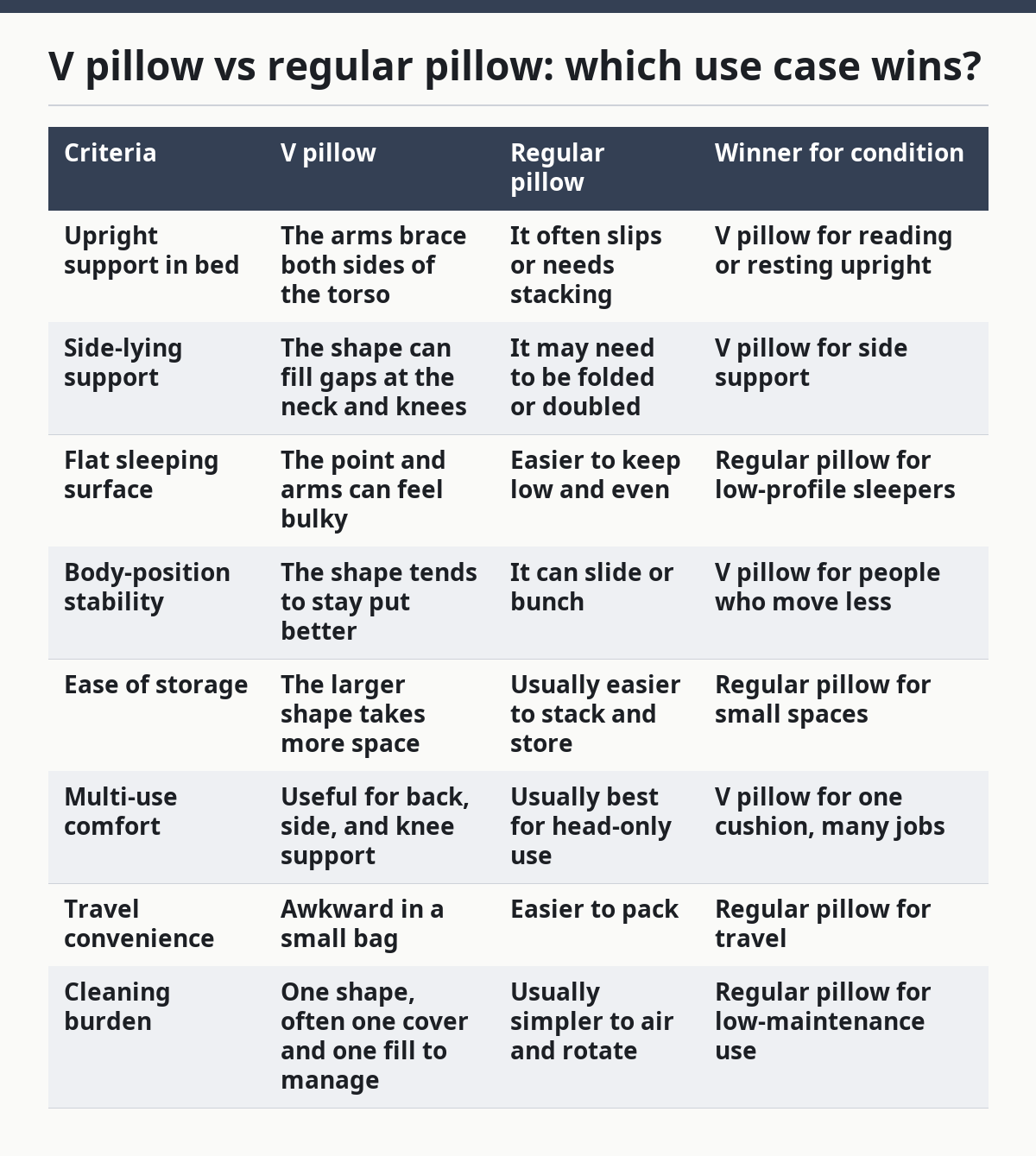
The V pillow wins when the problem is support, not just softness. It loses when the reader wants the lightest possible bedding item, because the shape is bulkier and less forgiving. If the goal is sleeping flat through the night, a regular pillow is usually the better choice.
Overall, a V pillow is not the best answer for every bed. If the arms are too thick or the filling is too springy, the pillow can push the body into a position that feels awkward after 15 minutes.
Who should use one, and who should skip it?
A V pillow is best for people who need support in a fixed position, and it is a poor fit for people who want a light, low, no-fuss sleep pillow. That split matters more than brand, fabric, or color.
The strongest match is someone who reads in bed, rests upright for recovery, or wants help holding a side-lying position. It is also useful when one piece needs to replace two or three loose pillows. That can make the bed less messy and keep the support more consistent through the evening.
It is also a practical choice during pregnancy support, especially for side resting, because the shape can support both the back and the knees. I would still keep the advice general here: body changes vary, and a clinician or midwife should guide support choices if pain, swelling, or breathing trouble is involved. A pillow helps with comfort; it does not treat a medical problem.
This is not the right choice for someone who shifts position all night and dislikes anything firm behind the neck. It is also a weak pick for very small beds, because the V shape takes more room than a standard pillow. If the pillow crowds the mattress edge or forces an elbow into the rail, it is too large for that setup.
The other group that should skip it is anyone who wants a pillow mainly for quick travel or easy packing. A V pillow is useful at home, but it is not built for a carry-on bag. That is a shape problem, not a quality problem.
How do I clean and dry it?
A V pillow should be cleaned by following the care label, and the removable cover usually needs washing more often than the inner fill. That rule matters because most of the skin oil, sweat, and dust sits on the surface first.
If the pillow has a zipped outer cover, start there. Wash the cover according to the label, then dry it fully before refitting. If the label allows a 30°C or 40°C wash, use the gentler setting unless the care instructions say otherwise. If the label gives a different limit, the label wins.
The inner cushion needs a different approach. Some fills can be aired, spot-cleaned, or gently washed, while others should not be soaked at all. A memory foam or shaped fill can hold moisture deep inside, which makes drying slow. A fibre fill usually dries more easily, but it can clump if it is twisted or overheated.
Drying is the step people get wrong most often. The pillow must be fully dry through the middle before it goes back on the bed, because trapped dampness can cause odor and flatten the fill. If the inside feels cool or heavy, it is not ready yet. A partly dried pillow can look fine on the outside and still be wrong in the center.
For a general care check, the guidance from the NHS sleep advice pages and MedlinePlus sleep guidance both reinforce a simple point: sleep comfort improves when the bed setup is clean, dry, and not irritating. A V pillow follows the same logic, even though it is a support cushion rather than a medical device.
For washing and drying decisions, a manufacturer care label is the most reliable source. The Sleep Foundation’s pillow care guidance also notes that different fills need different cleaning methods, which is why the label should come first.
How do I keep it in shape for longer?
A V pillow keeps its shape when you protect the fill, rotate its use, and stop it from being crushed into the wrong form. The shape is its value, so shape care matters as much as cleaning.
Do not fold the arms back on themselves for long periods unless the maker says that is fine. Repeated folding can crease the fill and leave one side thinner than the other. If you store it in a cupboard, lay it flat or rest it in its natural V rather than bending it around another item.
Use a removable cover if the pillow came with one. That layer helps reduce wear on the main shell and slows soil build-up. It also means the inner pillow needs washing less often, which helps the fill last longer.
Fluff or reshape it after use if the fill allows it. A fibre-filled pillow often benefits from a light shake so the material spreads back into the arms. If the shape stays flat after basic reshaping, the pillow is telling you something: the fill may be tired, compressed, or uneven.
One useful checkpoint is time in use rather than a calendar date. If the pillow stops holding the head at the same height, or if one arm feels lower than the other, it has likely lost structure. That is the moment to reassess whether it still supports the body the way it should.
When should I replace it?
A V pillow should be replaced when it no longer holds its shape, dries badly, or starts to feel uneven under the body. That is the simplest and most honest rule.
The biggest warning sign is collapse. If the middle stays sunken after fluffing, the cushion is no longer giving even support. The second warning sign is persistent smell or dampness after cleaning. If the fill cannot dry properly, the pillow becomes harder to keep clean and less pleasant to use.
Visible lumps, flat spots, or a twisted arm shape are also reasons to replace it. Those changes matter because the V design depends on symmetry. When one side is higher than the other, the head and shoulders stop resting evenly.
I would also replace it if the outer cover is wearing through and the inner shell is starting to show. At that point, the surface is losing both comfort and hygiene. A cover can often be swapped, but the pillow itself should not stay in service once the structure is failing.
A good rule is to judge the pillow by function, not appearance. If it still looks neat but no longer supports a 20-minute rest without adjustment, it is done. If it still supports well after washing and drying, keep it in use.
What mistakes do people make most often?
The most common mistake is using a V pillow like a normal sleep pillow and expecting it to behave the same way. It is shaped for support, so it needs a more deliberate position than a flat cushion does.
Another mistake is over-washing the fill while ignoring the cover. The outer layer takes most of the grime, so that part usually needs more attention. Washing the inner cushion too often can shorten its useful life, especially if the fill is not meant for repeated soaking.
A third mistake is drying it too quickly on high heat. That can distort the shape, harden some fills, or trap moisture in the center. A slow, complete dry is safer than a fast one that leaves the inside damp.
People also expect one position to suit every body. It does not. A V pillow can be excellent for one person and awkward for another, especially if shoulder width, mattress height, or side-sleeping habits are different. The shape is fixed; the body is not.
Can I use it for pregnancy, recovery, or reading?
Yes, and that is where a V pillow often earns its keep. It can support the back while sitting up, cradle the knees while side-lying, and make a semi-upright rest less tiring.
For pregnancy support, the side-lying setup is usually the strongest use case because the pillow can reduce the gap between the knees, hips, and torso. That said, comfort needs change across pregnancy, so a clinician or midwife should guide anything tied to pain, swelling, or breathing issues. A cushion helps with position; it does not replace medical care.
For recovery after a minor strain or a long day, the pillow can make it easier to stay still without piling up three separate cushions. That stability is the point. It is less helpful if you need frequent position changes, because the shape can feel bulky when turned or shifted.
For reading, the support is straightforward. The V shape helps keep the upper body from sliding down the bed, and that can reduce the need to keep resetting the cushions. A 15-minute reading session and a 2-hour rest are both easier when the support stays where it was placed.
What should I buy if I am choosing between options?
Choose a V pillow if you want one shaped cushion for sitting up, side support, or knee support. Choose a regular pillow if you mainly want a flat, simple sleep surface and easy storage. Neither is right if you need very specific medical positioning, because that should be guided by a professional.
A V pillow makes the most sense when the bed setup changes during the day. It handles reading, resting, and side support without needing a stack of loose cushions. A regular pillow is better when the use is narrow and simple.
If the pillow will live on a sofa or bed all day, the V shape usually earns its space. If it has to be packed away every morning, the bulk becomes a drawback. That trade-off matters more than price, brand, or fabric pattern.
FAQ
How should a V pillow sit on the bed?
The point should face the part of the body that needs the least bulk, while the two arms spread out to support the shoulders, back, or knees. If the neck feels pushed forward, the pillow is too high or too close to the face. A quick adjustment of a few inches usually fixes the problem.
Can I wash the whole pillow in one go?
Only if the care label says the full pillow is washable. Many V pillows have a removable cover and an inner fill that need different care. If the label is unclear, treat the cover and the fill as separate items and avoid soaking the inner cushion until the instructions are certain.
Why does my V pillow go flat so quickly?
It is usually because the fill has been compressed, over-washed, or not dried fully after cleaning. A flat spot at the center is common when the pillow is used upright for long periods. If fluffing does not bring back the shape, the fill is likely past its best.
Is a V pillow good for side sleeping?
Yes, if the shape supports the neck and the knees without forcing the head up too high. It works best when the pillow fills the gap between the body and the mattress rather than creating a hump under the neck. If side sleeping feels twisted, the pillow is not the right height for that body position.
Drafted with AI; not yet reviewed by a person.
About the Author