What Makes a V-Shaped Pillow Cover Comfortable for Side Sleeping
Last updated: November 29, 2026
Quick answer: a comfortable V-shaped pillow cover for side sleeping or reading usually has smooth fabric, a close fit, and enough breathability to stay comfortable for at least 30 minutes without constant adjusting. A comfortable V-shaped pillow cover for side sleeping or reading is soft against the neck, smooth under the arms, and breathable enough for long reading sessions or side sleeping. The best choice follows the two arms of the V, keeps pressure off the jaw and shoulder, and stays cool enough that you do not keep flipping it after 10 minutes.
Key takeaways
- Comfort comes from how the fabric feels on skin, not just how the pillow looks.
- The neck and the inner V need the gentlest touch because those spots carry the most pressure.
- A good choice should support upright reading and side sleeping without making the pillow feel stiff.
- Breathability matters when the pillow stays under your head or arm for a long stretch.
- A cover that looks plush can still feel wrong if seams, zips, or rough trims sit in the wrong place.
What does a comfortable V-shaped pillow cover do?
A comfortable V-shaped pillow cover makes contact feel easy instead of noticeable. For side sleeping or reading, that means the fabric should reduce friction at the neck, help the arm rest naturally, and avoid hot spots where the jaw, shoulder, or forearm presses hardest.
That sounds simple, but the shape changes the job. A regular rectangular pillow cover only has one main surface. A V-shaped pillow has two arms and a center notch, so comfort depends on how the cover behaves at all three points. If the fabric is stiff, the V can feel sharp at the inner angle. If it is too slick, the head may slide out of place during a 20-minute read in bed.
This is where the phrase “support pillow” matters. A support pillow is meant to hold position, not sink flat like a decorative bed cushion. The cover should let the support do its job while still feeling soft where skin touches it. A good one also avoids bulky trim that can rub against the neck or the underside of the forearm. For more on the pillow’s shape, see the main V-shaped pillow page.
For a reader comparing options, the main question is not “Which cover looks nicest?” It is “Which one disappears once I settle in?” That is the target. If a cover draws attention to itself after 5 minutes, it is not comfortable enough for this use.
How should the fabric feel against the neck?
The fabric should feel smooth, low-friction, and gentle at the neck, because that is the first place a bad cover makes itself known. A rough weave can irritate skin even when the pillow itself is well shaped. According to the American Academy of Dermatology, friction and rough contact can aggravate sensitive skin.
The neck is sensitive because it bends and shifts every time you turn your head. If the fabric grabs instead of glides, the pillow starts to feel like a brace instead of a rest. That is a problem for side sleeping, where the neck already carries uneven pressure, and for reading in bed, where the head may lean forward or to one side for a long time. The National Sleep Foundation notes that sleep comfort depends on support and pressure relief, not just softness.
A soft feel does not have to mean heavy or fuzzy. In many cases, the better feel comes from a smooth surface with a clean finish, not from extra pile or bulk. A plush surface can be cozy for 5 minutes and then too warm or too clingy for a full evening. That trade-off matters more than the word “soft” on its own.
The safe rule is simple: if the neck area feels scratchy, draggy, or stiff when you rub it for a few seconds, it will likely feel worse after 30 minutes. A comfortable V-shaped pillow cover should be almost forgettable at the collar line and under the jaw.
Why does the shape around the arms matter?
The shape around the arms matters because the arms carry the forearm and shoulder, and the wrong fabric can turn those contact points into pressure spots. On a V-shaped pillow, the two arms are not just decoration; they are the places your body settles into.
For side sleeping, one arm often sits under the head or neck while the other supports the upper body. If the cover is too slippery, the arm under the head can slide and make the neck twist. If it is too rough, the forearm can feel irritated, especially when the elbow rests in one place for more than 15 minutes. Reading in bed has the same problem from a different angle: the arms must support the chest and shoulders while the head stays lifted.
Seams matter here too. A thick seam or a zipper placed along the wrong edge can press right where the forearm lands. That kind of detail sounds small, but it is often the difference between “comfortable enough” and “I keep shifting this thing.”
A good V-shaped pillow cover lets the arms keep their contour without feeling lumpy. It should hold close to the pillow shape, not balloon away from it. If the cover hangs loose, the support feels less stable. If it is pulled too tight, the surface can feel hard and tense.
What makes it better for reading in bed?
A comfortable V-shaped pillow cover for reading in bed keeps the upper body stable without making the chest, neck, or elbows work too hard. The reader is usually half-upright, often with the shoulders rolled forward a little, so the cover has to manage both support and skin contact.
Reading creates a different pressure pattern from sleeping. The head is not always fully on the pillow, and the forearms may rest across the pillow for 30 minutes or longer. That means the cover needs enough softness for bare skin, but not so much loft or slipperiness that the body keeps sinking or sliding. A cover that works for sleep only can still fail for reading if it pushes the shoulders forward or bunches at the center notch.
A useful way to think about it is this: a good reading setup feels like a soft shelf, not a loose throw. The pillow should support the lower neck and upper back area without forcing the chin upward. If the cover bunches in the notch, the head may tilt uncomfortably. If it is too flat and thin-feeling, the pillow can lose the cradle effect that makes reading easier on the arms.
For readers using a V-shaped support pillow, the comfort test is whether the body can stay in one position long enough to finish a chapter. If there is constant adjusting, the cover is not doing enough.
Which details create pressure points?
Pressure points usually come from seams, zips, stiff edges, and fabric that does not move with the body. On a V-shaped pillow cover, those details matter because the shape has more corners and joins than a plain rectangle.
The inner point of the V is a common trouble spot. If the fabric is too tight there, it can feel like a ridge against the neck or upper chest. The outer edges can also press into the shoulder if they are thick or stiff. Even a small zipper pull can become annoying when it lands under the arm during a long read.
A cover can also create pressure by trapping heat. When the surface feels warm and sticky, the body tends to shift more. That movement puts extra load on the same spots again and again. A cooler-feeling fabric often feels softer in practice because the skin is less likely to tense up.
Here is a simple comparison of comfort traits:
| Comfort feature | Better for side sleeping | Better for reading in bed | Why it matters |
|---|---|---|---|
| Soft, smooth surface | Yes | Yes | Reduces drag on neck and forearm |
| Firm, structured seams | Sometimes | Sometimes | Helps shape hold, but can press on skin |
| Breathable feel | Yes | Yes | Lowers heat buildup during long use |
| Loose, baggy fit | No | No | Can shift and ruin support |
| Tight, rigid fit | No | Sometimes | Holds shape, but can feel hard |
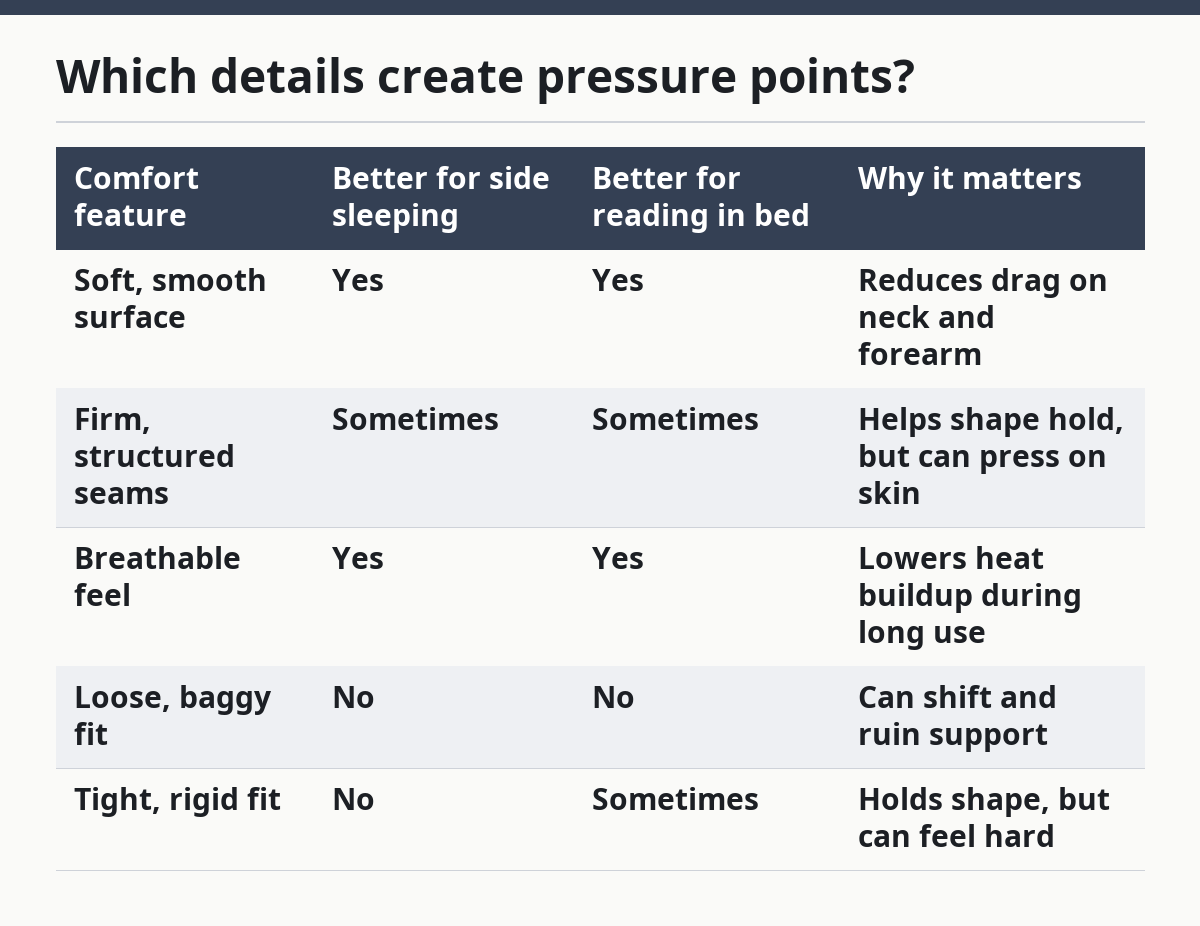
That table shows the trade-off clearly. The most comfortable option usually sits in the middle: soft enough for skin, structured enough to keep the V in place.
How do I choose one for my use case?
A practical choice starts with your main position, then your skin sensitivity, then how long you stay on the pillow. Side sleepers need less friction and fewer hard edges. Readers need steadier support and less bunching at the center notch.
Use this 4-step check before choosing a cover:
- Touch the neck area first for 10 seconds. The result to expect is a surface that feels smooth, not scratchy or grabby.
- Run your hand along both arms of the V. The result to expect is even contact, with no stiff ridge at the seam or corner.
- Press the center notch where the pillow opens. The result to expect is a shape that flexes a little without collapsing flat.
- Hold the edge where a zipper or closure sits. The result to expect is a finish that does not feel bulky against the shoulder or jaw.
If you want more background on the shape itself, the hub page on the main V-shaped pillow explains the core pillow design and how it supports the head and neck. This page stays focused on the cover, which is where comfort is often won or lost.
A cover that works for one person may still be wrong for another. Someone who sleeps on the side all night may want a smoother, quieter surface. Someone who reads upright in bed may prefer a bit more structure so the support pillow does not collapse under the elbows. That is the real decision point, not fabric labels alone.
What should I avoid if comfort matters?
You should avoid covers that are rough, noisy, too tight, or oddly trimmed, because those features cost comfort fast. A pretty finish can still be a bad choice if it makes the pillow feel hot or sharp.
The most common mistake is choosing by appearance alone. A glossy fabric may look neat in a photo, but it can slide under the head and force constant adjustment. Another mistake is ignoring the inner angle of the V. If that point is stiff, the pillow may feel fine at the edges and wrong the moment the neck settles in.
There is also a trap in going too soft. A very plush surface can feel nice for the first minute and then get warm, heavy, or unstable. For reading in bed, that can mean the head sinks forward and the shoulders start working harder. For side sleeping, that can mean the support shifts out of line and the neck no longer feels level.
A final mistake is forgetting the closure. A zipper hidden poorly or placed where the shoulder rests can turn into a small but constant irritation. Comfort is often lost in these small parts. If a cover feels fine everywhere except one seam, that one seam can still ruin the whole thing.
The most reliable option is the one that stays comfortable after the novelty wears off. If you feel the fabric, the seams, or the shape more than you feel the support, keep looking.
What fabric feels best against the neck?
The fabric that feels best against the neck is usually the one that feels smooth, low-friction, and cool enough not to make the skin tense up. That matters more than a fancy label or a glossy look. If the neck area feels scratchy after a few seconds, it is unlikely to feel better after 30 minutes.
Should a support pillow cover be soft or firm?
A support pillow cover should be soft on the surface and firm enough to keep the shape below it. That balance matters because the cover touches skin, while the pillow does the holding. Too soft, and the support can collapse or shift. Too firm, and the neck, jaw, or shoulder can feel pressed.
What makes a v pillow cover good for reading?
A good v pillow cover for reading keeps the pillow stable, smooth, and cool enough for a long session in bed. It should support the chest and shoulders without bunching at the center notch or pressing a hard edge into the arms. If you can sit with it for a chapter without constant adjustment, it is doing its job.
Drafted with AI; not yet reviewed by a person.
About the Author