How to Inspect Pillow Cover Corners for Durability
Last updated: November 19, 2026
Quick Answer: In about 2 minutes per cover, you can inspect pillow cover corners for durability by checking the seam, the fabric pull, and the stress point under bright light. In How to Inspect Pillow Cover Corners for Durability, the corner seam usually shows wear before the rest of the cover does. Check the corner seam, the fabric pull, and the stress point first—that tells you more than a quick glance at the front panel. The steps below show what holds up, what fails, and what to skip.
Key Takeaways
- Corners fail first because they take the pull from the pillow insert corner every time the cover is stuffed, fluffed, or sat on.
- A strong corner shows even stitching, clean seam lines, and no puckering where the fabric turns.
- Loose threads, thin spots, and a stretched corner shape are early warning signs.
- Reinforcement matters most at the stress point, not just along the visible edge.
- A close look under good light, then a gentle pull at the corner fold, is the quickest basic check.
What a durable corner should look like
A durable corner looks square, flat, and calm under tension, not twisted or puffed out. The corner seam should sit straight, the stitching should stay even through the turn, and the fabric should not thin out where the seam changes direction.
Picture this: you’re holding the cover at eye level and pinching one corner between thumb and forefinger. The right corner keeps its shape, the seam line stays tight, and the fabric does not open a gap when you tug it lightly. That is the look of a corner built to last, not one that will fray after a few months.
Look for these signs:
- Even stitch spacing around the turn, with no skipped or doubled spots.
- No puckering at the seam, which often means the fabric was forced around the corner.
- A crisp corner shape that still looks square when the cover is empty.
- No shiny stress marks on woven fabric, especially near the fold.
- No loose threads coming from the corner seam or opening.
A good corner does not need to look heavy-duty to be strong. It needs to look controlled. A neat turn with stable fabric is better than a bulky edge that has already started to warp.
How do you inspect a pillow cover corner step by step?
You inspect a pillow cover corner by checking the fabric, the stitching, and the shape under light tension, then confirming that the corner still holds its form. Start with a clean, empty cover if you can; a 20-inch insert can hide problems that show up only when the cover is stretched without support.
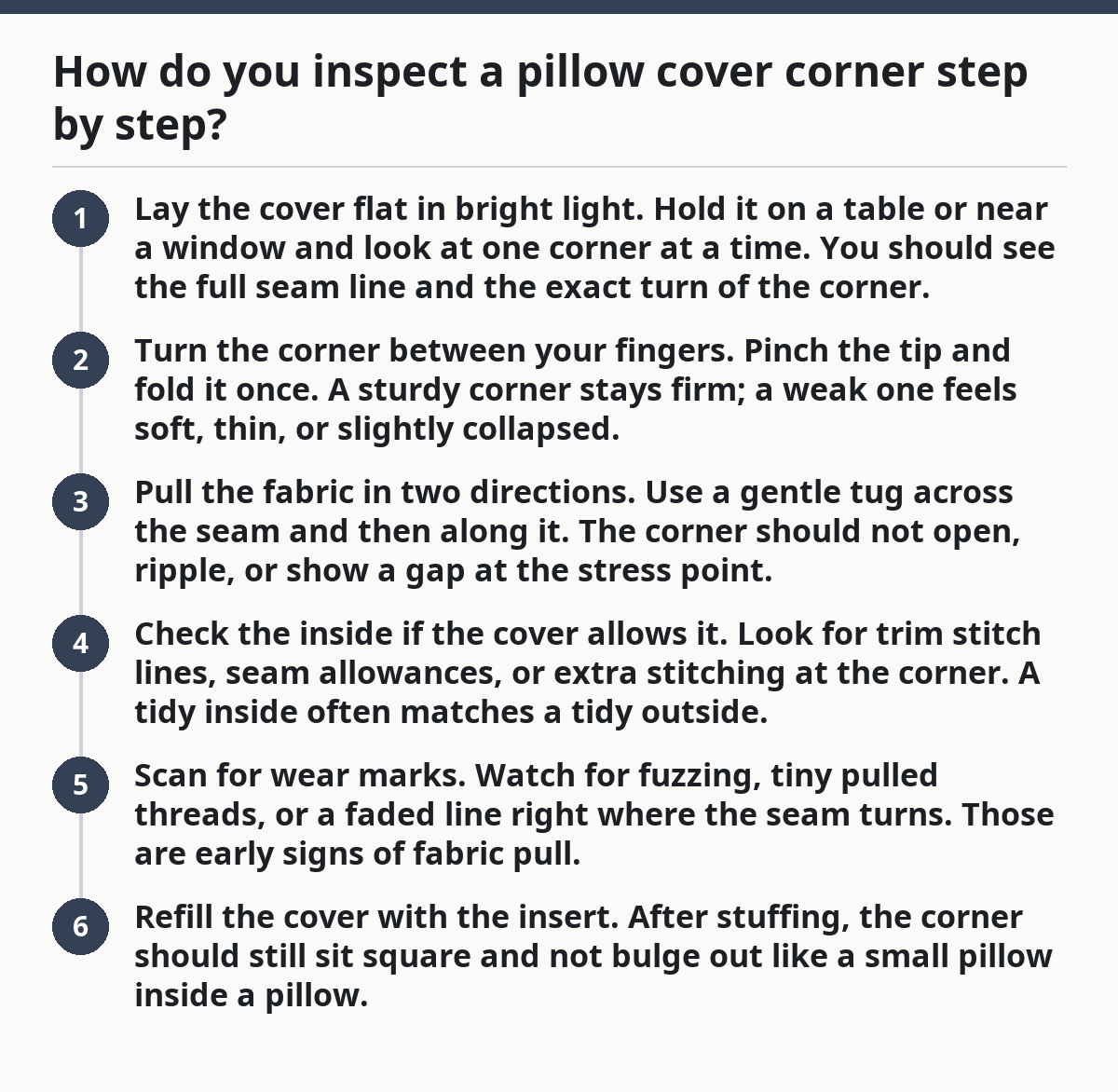
- Lay the cover flat in bright light. Hold it on a table or near a window and look at one corner at a time. You should see the full seam line and the exact turn of the corner.
- Turn the corner between your fingers. Pinch the tip and fold it once. A sturdy corner stays firm; a weak one feels soft, thin, or slightly collapsed.
- Pull the fabric in two directions. Use a gentle tug across the seam and then along it. The corner should not open, ripple, or show a gap at the stress point.
- Check the inside if the cover allows it. Look for trim stitch lines, seam allowances, or extra stitching at the corner. A tidy inside often matches a tidy outside.
- Scan for wear marks. Watch for fuzzing, tiny pulled threads, or a faded line right where the seam turns. Those are early signs of fabric pull.
- Refill the cover with the insert. After stuffing, the corner should still sit square and not bulge out like a small pillow inside a pillow.
This whole check takes about 2 minutes per cover once you know what to look for. You do not need tools.
What corner wear looks like before the seam fails
Corner wear usually starts as shape change, not a full tear. The corner stops looking sharp, the seam gets a little fuzzy, and the fabric begins to spread where the insert presses hardest.
Picture this: you flip the pillow over and one corner has gone soft while the other three still hold clean lines. That uneven look is your warning. The corner is taking more load than the rest of the cover, and the fibers are beginning to open up.
Watch for these early clues:
- Fabric pull at the point of the corner, especially on tight-weave cloth.
- A slight bulge or twist after the cover has been stuffed with the insert.
- Stress marks that look lighter, shinier, or more worn than nearby fabric.
- Stitch holes that look wider than the thread itself.
- A corner seam that no longer lies flat when you run a finger over it.
A corner can look fine from 1 meter away and still be failing close up. That is why a close inspection matters. Corners fail under repeated bending and pressure, so the first damage often hides in the turn, not the panel.
If the cover is decorative and rarely touched, mild wear may stay cosmetic for a long time. If the pillow gets regular use on a sofa, bed, or chair, the same wear can turn into a tear much sooner.
How to tell if the corner is reinforced
A reinforced corner usually has extra stitching, firmer structure, or a cleaner inside finish where the seam takes the load. You are looking for signs that the maker planned for the stress point, not just for appearance.
Picture this: you open the corner and see a neater inside than you expected. The seam allowance sits flat, the turn looks controlled, and the fabric at the corner does not feel flimsy when you press it between your fingers. That often means the corner was built with more care.
Check for these cues:
- Double stitching or an extra row of stitches near the corner.
- A seam allowance that stays even instead of narrowing sharply at the turn.
- A corner that feels slightly firmer than the rest of the edge.
- Inside stitching that does not wander or bunch.
- A stable shape after stuffing with the pillow insert corner pressed into place.
A reinforced corner is not the same thing as a thick corner. Thick fabric can still fail if the seam is sloppy. The real question is whether the corner can spread load without letting the seam open.
One simple test helps: press the corner flat with your palm, then lift the cover by that corner only for a second. If the corner stretches out of shape fast, it is weak. If it keeps its line, it is better built.
Which mistakes hide weak corners?
The biggest mistake is judging a corner by the front fabric only. A pretty cover with soft corners, loose threads, or a warped seam is still a weak cover.
Picture this: you admire the color and weave, then miss the tiny line of puckering at the corner turn. That small defect is often the first clue that the seam was stressed during sewing or that the fabric is starting to fatigue.
Common mistakes and what they cost:
- Ignoring the inside seam. Cost: you miss loose seam allowance or uneven stitching that can fail later.
- Checking only one corner. Cost: one good corner can hide three weak ones.
- Mistaking stiffness for strength. Cost: heavy interfacing or a thick seam can mask poor construction.
- Skipping the insert test. Cost: the cover may look fine empty but distort badly once stuffed.
- Overstretching the fabric during inspection. Cost: you can create false damage on a delicate weave.
The truth is, corner durability is about behavior under load. A corner that looks crisp on a shelf may still collapse after a few uses if the seam turn is weak.
If the cover has a hidden zipper or envelope opening, give the corner near that opening extra attention. Openings shift tension around, and that corner often sees more strain than the others.
For related construction checks, see the guide to pillow cover construction details and durability, plus the page on pillow insert fit. The Textile Exchange standards page and the ASTM textile test methods page also explain how fabric performance is evaluated.
How much should shape retention matter?
Shape retention matters because a corner that keeps its form usually lasts longer under daily use. If the corner bows out, twists, or goes soft after stuffing, the seam is already losing control of the fabric.
Picture this: you fit the insert and the pillow still looks neat from the side. The corner does not collapse into a wrinkle, and the seam line still reads as a straight edge. That is shape retention doing its job.
A quick shape check:
- Place the empty cover flat.
- Fold and release each corner once.
- Stuff the insert back in and smooth the edge.
- Compare all four corners under the same light.
A durable corner should return to its original outline without needing to be forced back into place. If you have to keep smoothing one corner every time, that corner is telling you it cannot hold the load well.
This matters more on square and knife-edge styles than on loose, casual covers. A crisp 18-inch or 20-inch decorative pillow cover should keep a cleaner corner than a relaxed throw cover, because the shape itself depends on that edge staying true.
When a weak corner is still acceptable
A weak corner can be acceptable when the cover is decorative, lightly handled, and easy to replace. If the pillow sits in a guest room or on a shelf display, mild corner wear may not justify a stricter standard.
Picture this: the cover looks great on the bed, but one corner has a little fuzz and a softer line than the others. If nobody is yanking, sitting, or re-stuffing it often, the flaw may stay minor for a long time.
Use this judgment:
- Acceptable if the wear is cosmetic, the seam is still closed, and the cover is used lightly.
- Not acceptable if the corner seam has opened, the fabric is thinning, or the shape has clearly drifted.
- Watch closely if the cover is washed often, used on a sofa, or stuffed with a dense insert.
A decorative use case does not erase poor construction. It only slows the damage. If you need a cover that will take regular handling, a weak corner is the wrong choice.
For broader construction checks, the hub on pillow cover construction details and durability covers the rest of the build, but the corner still deserves its own inspection.
Why do pillow cover corners wear out first?
Pillow cover corners wear out first because they take the highest bend and pull each time the insert shifts, the cover is fluffed, or the pillow is sat on. The corner seam concentrates stress into a small area, so tiny flaws show up there before they spread across the whole cover. A corner with fabric pull or a stressed seam is often the earliest failure point.
How can you tell if a corner is reinforced?
A reinforced corner usually feels firmer, keeps its shape better, and shows cleaner stitching at the turn. Look for an even seam allowance, double stitching, or a corner that does not spread when you press and lift it gently. A reinforced corner should resist twisting and should not show obvious puckering at the stress point.
Drafted with AI; not yet reviewed by a person.
About the Author