Do V-Shaped Pillow Covers Need a Zipper Guard or Covered Seam?
Last updated: November 29, 2026
Quick answer: usually yes — for a V-shaped pillow cover that touches bare skin for long periods, a zipper guard or, better, a covered seam is the safer comfort choice. A 1 cm to 1.5 cm seam allowance helps you finish the edge cleanly, and the best result depends on where the cover touches the neck, jaw, or cheek.
Key takeaways
- A zipper guard helps most when the cover touches bare skin for hours at a time.
- A covered seam is the better choice when the edge runs near the face or neck.
- A plain seam can feel fine if the zipper sits away from the contact zone, but the zip tape may still press through.
- The goal is not fancy finishing; it is stopping hard edges, scratchy thread tails, and zipper teeth from showing through.
- If you are choosing between the two, comfort usually matters more than speed at the sewing machine.
What is the real problem here?
The real problem is skin contact, not the zipper itself. On a V-shaped pillow, the inner edge often rests near the neck or upper shoulder, so a 1 cm strip of rough tape or a stiff seam can be felt quickly.
A zipper guard adds a soft layer between the closure and the body. A covered seam hides the seam allowance so the stitch line and cut edge do not sit right on the skin. That matters more on a V-shaped pillow than on a cushion that stays under a blanket or on a chair.
The detail many people miss is that the shape creates two pressure lines instead of one. The point of the V can pull the fabric tighter, which makes a standard sewing seam easier to feel. A clean finish is not just neatness; it changes how the cover wears against the neck over a whole night or a long rest.
If the cover is for a V-shaped pillow used with a pillowcase or an extra layer on top, the need is lower. If the cover is the only thing between the filling and the body, the comfort risk rises quickly.
Do V-shaped pillow covers need a zipper guard or covered seam?
They do when comfort matters more than speed, and a covered seam is usually the safer pick for skin feel. A zipper guard is useful when the zipper must stay in the design, but the guard alone does not always remove the ridge from the seam allowance.
Here is the clean way to think about the choice:
| Finish | Best for | What it solves | Main drawback |
|---|---|---|---|
| Zipper guard | A cover that still needs a zipper closure | Softens the area over the zip tape and helps stop rubbing | Adds one more sewing step and can make the edge thicker |
| Covered seam | Skin-facing edges near the neck or face | Hides raw edges and stitch ridges | Takes more careful sewing and can add bulk at corners |
| Plain sewn seam | Decorative covers or low-contact use | Fast and simple construction | Most likely to feel scratchy or press through |
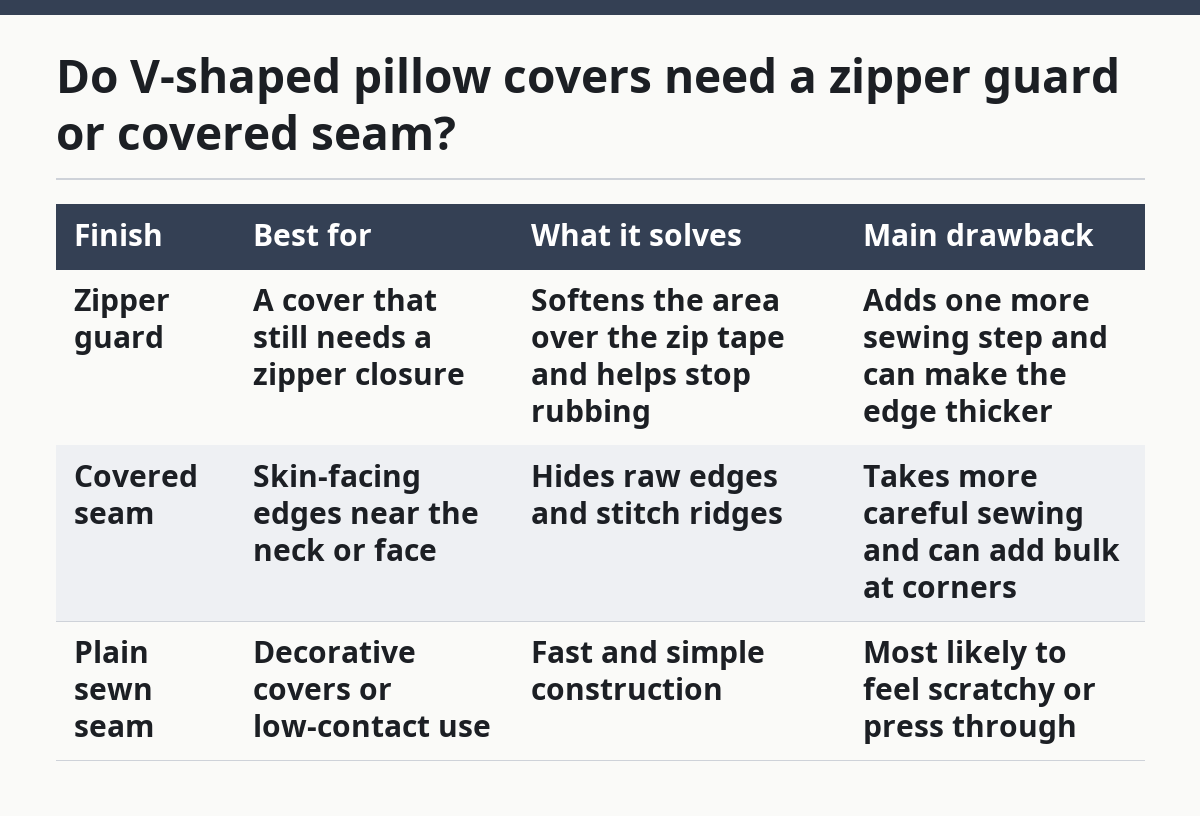
A zipper guard is useful, but it is not a full fix if the seam finish underneath is rough. A covered seam is better when the edge will touch skin directly. If both are used together, the result is usually the most comfortable, though it can make the seam zone a bit bulkier around a tight curve or a pointed corner.
This is also where the V-shape matters. A straight cushion can hide a little stiffness more easily. A V-shaped pillow cover has more edge length near the neck, so any scratchy spot has more chance of being noticed.
How do I finish the seam so it feels soft?
A soft finish starts with keeping the seam allowance flat and hiding the edge that could scratch. A 1 cm to 1.5 cm seam allowance is easier to control than a very narrow one, because it gives enough fabric to fold or enclose cleanly.
Use this order when you want the edge to feel better against skin:
- Sew the main seam with a straight, even line, then press it flat so the fold sits smoothly instead of ridge-high.
- Trim only the bulky spots, not the whole allowance, so the edge does not become sharp or uneven.
- Enclose the raw edge with a cover or fold the fabric over it, which keeps thread ends from rubbing the neck.
- Place the zipper so the pull and teeth sit away from the inside contact zone, especially near the point of the V.
- Run a finger along the finished edge after turning the cover right-side out; the result should feel smooth, not corded or bumpy.
The easiest mistake is thinking that a neat stitch line equals comfort. It does not. A stitch line can look tidy and still leave a ridge that presses through after 10 minutes of use. The better test is touch, not appearance.
For fabric choice, the seam finish should match the weight of the cloth. Light fabric can show every fold, while heavier fabric can make the edge feel thicker if the seam is doubled too much. A covered seam works best when the extra bulk is kept even instead of piled at one point. For general textile quality, OEKO-TEX Standard 100 is a widely used certification, and fabric guide pages on construction and care can help you match the finish to the cloth.
Where should the zipper sit on a V-shaped pillow cover?
The zipper should sit where the body is least likely to rest on it, not where it is easiest to sew. On a V-shaped pillow cover, that usually means keeping the closure away from the most active neck contact area and making sure the zip pull does not land under the jaw.
A common trap is placing the zipper along the nearest long edge without checking how the pillow is used. That can put the teeth right where the head turns. A zipper guard helps here because it covers the hardware, but the zipper position still matters more than the guard alone.
If the closure is close to a corner or point, leave enough room for the seam to turn without puckering. The point of the V can force the fabric to bunch, and a bunched edge is more likely to feel rough than a smooth one. A little planning at the layout stage saves a lot of fuss later.
If the cover will be opened often, the zipper also needs enough clearance for hand movement. A hidden closure may look tidy, but this page is not about hidden closure pillow covers. The issue here is simple comfort on a V-shaped pillow cover seam finish: if the zip is in the wrong place, even a good guard can feel clumsy. For zipper construction basics, see the zipper guide and CottonWorks for practical fabric information.
What goes wrong when people skip the guard?
Skipping the guard often leaves a hard edge, a scratchy seam, or both. The cost is usually not damage to the fabric; it is irritation that shows up when the cover is used for an hour or more.
Three mistakes show up again and again:
- Raw edges left exposed. The cost is rubbing and fraying. Use a covered seam or another enclosed finish instead.
- Zipper tape sitting flat against the body. The cost is pressure from the tape, even if the teeth are not exposed. Add a zipper guard or move the zipper away from the contact side.
- Bulky corners at the V point. The cost is a lump that sits exactly where the neck bends. Grade the seam allowance and press the point flat before turning.
A plain seam can be acceptable on a decorative outer piece, but it is a weak choice for a cover that touches skin directly. That is the part many generic guides miss: the answer changes with use, not just with sewing skill.
The other trade-off is bulk. A covered seam can feel better, but too much folded fabric at the point can create its own ridge. So the job is not to add every finish at once; it is to put softness where the body actually makes contact.
Which finish is best for skin contact?
A covered seam is usually best for skin contact, and a zipper guard is the better add-on when the closure still needs to sit nearby. If the cover will touch bare skin for long periods, that combination is the best practical choice for avoiding scratchy edges.
Think about the body area first. A neck, jaw, or cheek will notice a 2 mm ridge much faster than a hand or leg would. That is why a finish that looks small on the table can feel large in use. The V shape concentrates contact at the inside edge, so the finish there matters more than a decorative edge on the outside.
This is also where a simple rule helps. If the seam can be felt through one layer of fabric when you press it between two fingers, it is likely to be noticeable on skin too. A softer fabric will hide more, but it will not erase a poorly finished edge.
For people sensitive to scratchy stitching, the better call is to prioritize the seam finish over the speed of construction. For someone using the cover over another layer or mostly as a prop, a basic seam may be good enough. That is the honest line: the right answer depends on contact time and sensitivity.
For material guidance, the OEKO-TEX Standard 100 is a known textile certification that screens many products for harmful substances, and the CottonWorks site from Cotton Incorporated has practical fabric-care and construction guidance. Those sources do not decide your seam finish, but they help frame the larger comfort question around skin contact and textile choice.
FAQ
Is a zipper guard useful on a pillow cover?
Yes, a zipper guard is useful when the zipper sits near skin contact or when the zip tape feels stiff. It softens the edge around the closure and can keep the hardware from pressing through after an hour or more of use. It is most helpful on a V-shaped pillow cover that rests near the neck.
What seam finish feels best against skin?
A covered seam usually feels best against skin because it hides the raw edge and the seam allowance. It is the better pick when the cover touches the jaw, neck, or cheek. A plain seam is simpler, but it is more likely to show a ridge or scratchy edge through the fabric.
How do I avoid feeling the zipper on a V pillow cover?
Keep the zipper away from the main contact side, add a zipper guard, and press the seam flat before turning the cover right-side out. If the point of the V is bulky, trim and grade that area carefully so the closure does not build up a lump. The goal is a smooth edge, not just a closed one.
Drafted with AI; not yet reviewed by a person.
About the Author